Federal Science Expenditures and Personnel 2026/2027 - Activities in the natural sciences and engineering

Information for respondents

Authority to publish

Section 17 of the Statistics Act allows for the disclosure of certain information relating to an organization. For this survey, Statistics Canada will release the names of federal departments and agencies whose science and technology (S&T) expenditures surpass 2% of the total federal S&T expenditures for the 2025/2026 reference year. This applies to departments that previously authorized publication in the 2024/2025 collection cycle. For each of these departments, data on expenditures and personnel will be published.

Respondent Information:

  • Name of person who approved the data reported
  • Signature
  • Official position
  • Program
  • Department or agency
  • E-mail address
  • Telephone number

Enquiries to be directed to:

  • Name
  • Date
  • Position title
  • Telephone number
  • Email address
  • Fax number

Purpose

This survey collects financial and operating data on expenditures and full-time equivalent personnel on the scientific activities of Federal Government Public Administration in Canada.

Additional information

The data collected are used by federal, territorial and provincial science policy analysts, and are also part of the gross domestic expenditures on research and development (GERD). Your information may also be used by Statistics Canada for other statistical and research purposes.

Authority

Collected under the authority of the Statistics Act, Revised Statutes of Canada, 1985, Chapter S-19.

Completion of this questionnaire is a legal requirement under this Act.

Confidentiality

Statistics Canada is prohibited by law from releasing any information it collects which could identify any person, business, or organization, unless consent has been given by the respondent or as permitted by the Statistics Act. Statistics Canada will use the information from this survey for statistical purposes.

Data-sharing agreements

To reduce respondent burden, Statistics Canada has entered into data-sharing agreements with provincial and territorial statistical agencies and other government organizations, which have agreed to keep the data confidential and use them only for statistical purposes. Statistics Canada will only share data from this survey with those organizations that have demonstrated a requirement to use the data.

Section 11 of the Statistics Act provides for the sharing of information with provincial and territorial statistical agencies that meet certain conditions. These agencies must have the legislative authority to collect the same information, on a mandatory basis, and the legislation must provide substantially the same provisions for confidentiality and penalties for disclosure of confidential information as the Statistics Act. Because these agencies have the legal authority to compel businesses to provide the same information, consent is not requested and businesses may not object to the sharing of the data.

For this survey, there are Section 11 agreements with the provincial and territorial statistical agencies of Newfoundland and Labrador, Nova Scotia, New Brunswick, Quebec, Ontario, Manitoba, Saskatchewan, Alberta, British Columbia, and the Yukon.

The shared data will be limited to information pertaining to federal departments and agencies located within the jurisdiction of the respective province or territory.

Section 12 of the Statistics Act provides for the sharing of information with federal, provincial or territorial government organizations. Under Section 12, you may refuse to share your information with any of these organizations by writing a letter of objection to the Chief Statistician and returning it with the completed questionnaire. Please specify the organizations with which you do not want to share your data.

For this survey, there are Section 12 agreements with the statistical agencies of Prince Edward Island, the Northwest Territories, Nunavut, Innovation Science and Economic Development Canada (ISED), as well as the Office of the Chief Science Advisor (OCSA) of ISED.

The shared data will be limited to information pertaining to federal departments and agencies located within the jurisdiction of the respective province or territory.

Record linkage

To enhance the data from this survey and to minimize the reporting burden, Statistics Canada may combine it with information from other surveys or from administrative sources.

Security of emails and faxes

Statistics Canada advises you that there could be a risk of disclosure during the transmission of information by facsimile or e-mail. However, upon receipt, Statistics Canada will provide the guaranteed level of protection afforded all information collected under the authority of the Statistics Act.

Return procedures

Please forward the completed questionnaire and listing of extramural performers through the Electronic File Transfer service (EFT).
For further inquiries:

Thank you for your co-operation.

FSEP - Introduction

This introduction is intended to provide an overview of the process of collecting science expenditure data; definitions of and explanatory notes on natural sciences and engineering, social sciences, humanities and the arts, scientific and technological activities, performance sectors, and other terms used are given in subsequent sections.

The collection of science expenditure data is organized by the Centre for Innovation, Technology and Enterprise Statistics (CITES) of Statistics Canada. This exercise was formerly conducted under the aegis of the Treasury Board of Canada Secretariat but is now solely a Statistics Canada survey.

Collection is undertaken to gather essential data describing the recent, current and proposed state of the federal resources allocated to science. Federal science expenditures data are provided to Innovation, Science and Economic Development Canada who in turn use the data in the development of advice to the Assistant Deputy Ministers' Steering Committee on the Management of S&T, their Minister and the Treasury Board of Canada Secretariat, as well as in policy development and in monitoring the implementation of science policies. Statistics Canada maintains historical expenditure series in natural sciences and engineering dating back to 1963 and to 1971 in the social sciences, humanities and the arts. These data are available through the Centre for Innovation, Technology and Enterprise Statistics (CITES) or through special requests.

The basic reporting unit is the budgetary program of a department or agency. Each budgetary program forms the subject of separate scientific expenditure reports for the natural and for the social science activities within it. Both the program and the program activities within it may be scientific in whole or in part only. Only expenditures on the scientific components of a program or its activity are reported. In some programs it will be difficult to distinguish between the natural and social sciences. However, some allocation must be made and in determining this allocation, the dominant orientation of the projects and the area of expertise of the personnel involved must be considered. Detailed definitions are given on the following pages.

On the questionnaires, the identified expenditures are looked at from several different viewpoints and in various subdivisions. Expenditures on research and development (R&D) and related scientific activities (RSA) are subdivided to provide an indication of the "what" of a department's scientific effort. Expenditures in each category of scientific activity are further subdivided into "current" and "capital" segments. Current expenditures are additionally subdivided by sector, to indicate the "where" and "by whom" the activity is performed (e.g., in business enterprise, in higher education).

The human resources allocated to scientific activities are summarized in terms of the involved categories of personnel (scientific and professional, technical, etc.) and the principal focus of their efforts (R&D, RSA and, administration of extramural programs).

When completed, checked for consistency with previous reports, entered into the database and totaled along the various dimensions, these data provide snapshots of the federal resources allocated to science, supporting not only the work of central agencies but also the submissions of departments and agencies requesting resources.

Purpose

This survey collects financial and operating data on expenditures and full-time equivalent personnel on the scientific activities of Federal Government Public Administration in Canada.

Question 1: Expenditures by activity and performer

General

The natural sciences and engineering consist of disciplines concerned with understanding, exploring, developing or utilizing the natural world. Included are the engineering and technology, mathematical, computer and information sciences, physical sciences, medical and health sciences, and agricultural sciences, veterinary sciences and forestry.

Expenditures by activity and performer

Scientific and technological (S&T) activities can be defined as all systematic activities which are closely concerned with the generation, advancement, dissemination and application of scientific and technology knowledge in all fields of science and technology, that is the natural sciences and engineering, and the social sciences, humanities and the arts.

The central activity is scientific research and experimental development (R&D). In addition there are a number of activities closely related to R&D, and are termed related scientific activities (RSA). Those identified as being appropriate for the federal government in the natural sciences are: scientific data collection, information services, special services and studies and education support.

The performer is equivalent to the sector in which the scientific activity is conducted. The basic distinction is between intramural and extramural performance. Extramural payments are classified on the basis of the performance sectors to which they are made. The appropriate extramural performers are business enterprise, higher education, Canadian non-profit institutions, provincial, territorial and municipal government, and foreign performers.

I. Performers

lntramural activities include all current expenditures incurred for scientific activities carried out by in-house personnel of units assigned to the program; the related gross fixed capital expenditures (acquisition of land, buildings, machinery and equipment for scientific activities); the administration of scientific activities by program employees; and, the purchase of goods and services to support in-house scientific activities (include royalties or licences for the use of patents and other intellectual property rights, the lease of capital goods (machinery and equipment, etc.) and the rental of buildings to support scientific activities performed by the statistical unit in the reference year).

The intramural expenditures reported for scientific activities are those direct costs, including salaries, associated with scientific programs. The costs should include that portion of a program's contribution to employee benefit plans (e.g., superannuation and compensation) which is applicable to the scientific personnel within the program. The summation of intramural R&D activity is synonymous with the performance of R&D for the entire economy (GERD).

Extramural performers are groups being funded by the federal government sector for S&T activities. In this survey the extramural performers include:

  • Business enterprise – business and government enterprises including public utilities and government-owned firms. Both financial and non-financial corporations are included. Incorporated consultants or unincorporated individuals providing scientific and engineering services are also included. Industrial research institutes located at Canadian universities are considered to be in the higher education sector.
  • Higher education – comprises all universities, colleges of technology and other institutes of post-secondary education, whatever their source of finance or legal status. It also includes teaching hospitals (non-teaching hospitals are in the Canadian non-profit sector), all research institutes, centers, experimental stations and clinics that have their scientific activities under the direct control of, or administered by, or associated with, the higher education establishments.
  • Canadian non-profit institutions – charitable foundations, voluntary health organizations, scientific and professional societies, non-teaching hospitals (teaching hospitals are in the higher education sector) and other organizations not established to earn profits. Non-profit institutions primarily serving or controlled by another sector should be included in the controlling sector.
  • Provincial, territorial and municipal governments – departments and agencies of these governments as well as provincial research organizations and self-governing First Nations and Tribal Councils. Government enterprises, such as provincial utilities are included in the business enterprise sector, and non-teaching hospitals in the Canadian non-profit institutions sector.
  • Foreign performers – all foreign government agencies, foreign companies (including foreign subsidiaries of Canadian firms), international organizations, non-resident foreign nationals and Canadians studying or teaching abroad.

II. Research and experimental development (R&D)

Research and experimental development (R&D) - comprise creative and systematic work undertaken in order to increase the stock of knowledge - including knowledge of humankind, culture and society - and to devise new applications of available knowledge.

R&D activities may be aimed at achieving either specific or general objectives. R&D is always aimed at new findings, based on original concepts (and their interpretation) or hypotheses. It is largely uncertain about its final outcome (or at least about the quantity of time and resources needed to achieve it), it is planned for and budgeted (even when carried out by individuals), and it is aimed at producing results that could be either freely transferred or traded in a marketplace.

For an activity to be an R&D activity, it must satisfy five core criteria:

  • To be aimed at new findings (novel);
  • To be based on original, not obvious, concepts and hypothesis (creative);
  • To be uncertain about the final outcome (uncertainty);
  • To be planned and budgeted (systematic);
  • To lead to results that could be possibly reproduced (transferable/or reproducible).

Examples of R&D:

  • A special investigation of a particular mortality in order to establish the side effects of certain cancer treatment is R&D.
  • The investigation of new methods of measuring temperature is R&D, as is the study and development of new models for weather prediction.
  • Investigation on the genetics of the species of plants in a forest in an attempt to understand natural controls for disease or pest resistance.
  • The development of new application software and substantial improvements to operating systems and application programs.

R&D is generally carried out by specialized R&D units. However, an R&D project may also involve the use of non R&D facilities (e.g., testing grounds), the purchase or construction of specialized equipment and materials, and the assistance of other units. Costs of such items, attributable to the project, are to be considered R&D costs.

R&D may also be carried out by units normally engaged in other functions (e.g. a marine survey ship used for hydrological research, a geological survey team may be directed to work in a certain area in order to provide data for a geophysical research project). Such effort is part of an R&D project and, again, so far as is practical, the costs should be assigned to R&D expenditures.

On the other hand, R&D units may also be engaged in non R&D activities such as technical advisory services, testing, and construction of special equipment for other units. So far as is practical, the effort devoted to such operations should be included in the related scientific activities (RSA).

1. In-house R&D – R&D performed by personnel of the reporting program. It may include R&D carried out on behalf of another program or federal government department.

2. R&D contracts – contracts to an outside institution or individual to fund R&D performed by the institution or individual. The criterion is: would the performer report the R&D contract as in-house (intramural) R&D that is government-funded? If the answer is yes the activity would be an R&D contract. If no, and the funding is for the purchase of goods and services to support the in-house R&D of the federal government department, it should be reported as In-house R&D (Item 7).

3. R&D grants, contributions and fellowships – awards to organizations or individuals for the conduct of R&D and intended to benefit the recipients rather than provide the program with goods, services or information. These funds are normally identical to that portion of the budgetary "grants, contributions and fellowships" line object of expenditure which is devoted to R&D activities.

4. Research fellowships – awards to individuals for advanced research training and experience. Awards intended primarily to support the education of the recipients should be reported as "education support".

5. Administration of extramural programs – the costs of identifiable units engaged in the administration of contracts and grants and contributions for scientific activities that are to be performed outside the federal government. These expenditures should be broken down by the type of scientific activity supported, i.e. R&D or RSA.

6. Capital expenditures – the annual gross amount paid for the acquisition of fixed assets that are used repeatedly or continuously in the performance of scientific activities for more than one year. They should be reported in full for the period when they took place, whether acquired or developed in house, and should not be registered as an element of depreciation.

The most relevant types of assets used for capital expenditures are:

  • Land and buildings
  • Machinery and equipment
  • Capitalized computer software
  • Other intellectual property products

III. Related scientific activities (RSA)

Related scientific activities (RSA) are all systematic activities which are closely concerned with the generation, advancement, dissemination and application of scientific and technological knowledge. The types of related scientific activities for the natural sciences and engineering are described below.

7. In-house RSA – RSA performed by personnel of the reporting program. It may include RSA carried out on behalf of another program or federal government department.

In-house RSA activities include all current expenditures incurred for scientific activities carried out by in-house personnel of units assigned to the program; the purchase of goods and services to support in-house scientific activities (include royalties or licences for the use of patents and other intellectual property rights, and the rental of buildings to support scientific activities performed by the statistical unit in the reference year). Also include expenses of persons who provide ancillary services such as security, cleaning and maintenance work, finance and administration that are proportional to the RSA being conducted. However, the personnel providing these services are not to be included in the in-house personnel counts (see Section 2. Personnel).

The intramural expenditures reported to RSA are those direct costs, including salaries, associated with scientific programs. The cost should include that portion of a program's contribution to employee benefit plans (e.g., superannuation and compensation) which is applicable to the scientific personnel within the program. Also include the costs of self-employed individuals, consultants and researchers who are working on-site on the departments' RSA projects.

8. RSA contracts – contracts to an outside institution or individual to fund RSA performed by the institution or individual. The criterion is: would the performer report the RSA contract as in-house (intramural) RSA that is government-funded? If the answer is yes the activity would be an RSA contract. If no, and the funding is for the purchase of goods and services to support the in-house RSA of the federal government department, it should be reported as In-house RSA (Item 7).

Contracts to other federal government departments should be reported as a transfer of funds in question 3A (i) and 3A (ii) of the questionnaire.

9. RSA grants and contributions – awards to organizations or individuals for the conduct of RSA and intended to benefit the recipients rather than provide the program with goods, services or information. These funds are normally identical to that portion of the budgetary "grants and contributions" line object of expenditure which is devoted to RSA.

In-house RSA, RSA Contracts and RSA grants and contributions can include the following items:

  • Scientific data collection – the gathering, processing, collating and analyzing of data on natural phenomena. These data are normally the results of surveys, routine laboratory analyses or compilations of operating records.
    Data collected as part of an existing or proposed research project are charged to research. Similarly, the costs of analyzing existing data as part of a research project are R&D costs, even when the data were originally collected for some other purpose. The development of new techniques for data collection is also to be considered a research activity. Examples of RSA scientific data collection are: routine geological, hydrographic, oceanographic and topographic surveys; routine astronomical observations; maintenance of meteorological records; and wildlife and fisheries surveys.
  • Information services – all work directed to collecting, coding, analyzing, evaluating, recording, classifying, translating and disseminating scientific and technological information as well as museum services. Included are the operations of scientific and technical libraries, S&T consulting and advisory services, the Patent Office, the publication of scientific journals and monographs, and the organizing of scientific conferences. Grants for the publication of scholarly works are also included.
    General purpose information services or information services directed primarily towards the general public are excluded, as are general departmental and public libraries. When individual budgets exist, the costs of libraries which belong to institutions otherwise entirely classified to another activity, such as R&D, should be assigned to information services. The costs of printing and distributing reports from another activity, such as R&D, are normally attributed to that activity.
  • Sub category under Information services:
    • Museum services – the collecting, cataloguing and displaying of specimens of the natural world or of representations of natural phenomena. The activity involves a systematic attempt to preserve and display items from the natural world; in some ways it could be considered an extension of information services. The scientific activities of natural history museums, zoological and botanical gardens, aquaria, planetaria and nature reserves are included. Parks which are not primarily restricted reserves for certain fauna or flora are excluded. In all cases the costs of providing entertainment and recreation to visitors should be excluded (e.g. restaurants, children's gardens and museums).
      When a museum also covers not only natural history but also aspects of human cultural activities, the museum's resources should be appropriated between the natural and social sciences. However, museums of science and technology, war, etc., which display synthetic or artificial objects and may also illustrate the operations of certain technologies, should be considered as engaged in museum services in social sciences.
    • Special services and studies – work directed towards the establishment of national and provincial standards for materials, devices, products and processes; the calibration of secondary standards; non-routine quality testing; feasibility studies and demonstration projects.
  • Sub categories under Special services and studies include:
    • Testing and standardization – concerns the maintenance of national standards, the calibration of secondary standards and the non-routine testing and analysis of materials, components, products, processes, soils, atmosphere, etc. These activities are related scientific activities (RSA). The development of new measures for standards, or of new methods of measuring or testing, is R&D. Exclude routine testing such as monitoring radioactivity levels or soil tests before construction.
    • Feasibility studies – technical investigations of proposed engineering projects to provide additional information required to reach decisions on implementation. Besides feasibility studies, the related activity of demonstration projects are to be included. Demonstration projects involve the operation of scaled-up versions of a facility or process, or data on factors such as costs, operational characteristics, market demand and public acceptance. Projects called "demonstration projects" but which conform to the definition of R&D should be considered R&D. Once a facility or process is operated primarily to provide a service or to gain revenue, rather than as a demonstration, it should no longer be included with feasibility studies. In all demonstration projects, only the net costs should be considered.
    • Education support – grants to individuals or institutions on behalf of individuals which are intended to support the post-secondary education of students in technology and the natural sciences. General operating or capital grants are excluded. The activity includes the support of foreign students in their studies of the natural sciences at Canadian or foreign institutions. Grants intended primarily to support the research of individuals at universities are either R&D grants or research fellowships.
      Awards intended primarily to support the education of the recipients should be reported as "education support".

10. Administration of extramural programs – the costs of identifiable units engaged in the administration of contracts and grants and contributions for scientific activities that are to be performed outside the federal government. These expenditures should be broken down by the type of scientific activity supported, i.e. R&D or RSA.

11. Capital expenditures – the annual gross amount paid for the acquisition of fixed assets that are used repeatedly or continuously in the performance of scientific activities for more than one year. They should be reported in full for the period when they took place, whether acquired or developed in house, and should not be registered as an element of depreciation.

The most relevant types of assets used for capital expenditures are:

  • Land and buildings
  • Machinery and equipment
  • Capitalized computer software
  • Other intellectual property products

Question 2: Personnel

Full-time equivalent (FTE) – the ratio of working hours actually spent on scientific activities during a specific reference period divided by the total number of hours conventionally worked in the same period by an individual or a group. For example, an employee who is engaged in scientific activities for half a year has a full-time equivalence of 0.5. Personnel data reported should be consistent with expenditures data.

Scientific and professional – researchers and professionals engaged in the conception or creation of new knowledge. They conduct research and improve or develop concepts, theories, models, techniques instrumentation, software or operational methods. They require at least one academic degree or a nationally recognized professional qualification, as well as those with equivalent experience.

Technical – technicians and equivalent staff are persons whose main tasks require technical knowledge and experience in one or more fields of engineering, the physical and life sciences, or the social sciences, humanities and the arts. They perform scientific and technical tasks involving the application of concepts and operational methods and the use of research equipment, normally under the supervision of researchers.

Other – other supporting staff includes skilled and unskilled craftsmen, and administrative, secretarial and clerical staff participating in science and technology projects or directly associated with such projects.

Question 2: Personnel by gender

Gender – refers to current gender which may be different from sex assigned at birth and may be different from what is indicated on legal documents. Categories include: man, woman, and non-binary person.

Man – this category includes persons whose reported gender is male. It includes cisgender (cis) and transgender (trans) men. 

Woman – this category includes persons whose reported gender is female. It includes cisgender (cis) and transgender (trans) women. 

Non-binary person – this category includes persons whose reported gender is not exclusively male or female.

Question 3: Sources of funds

Question 3A (i). Transfers for natural sciences and engineering activities

Include payments and recipients for contracts, transfers and joint programs from/to other federal government departments. Please identify the amount and names of the origination and recipient programs.

Question 3A (ii). Sources of funds for total scientific and technological activities

This question identifies the sources of funds for expenditures on scientific activities reported for all three years. It will help to ensure that work funded from outside the department is not overlooked.

  • Departmental S&T budget – that portion of the total departmental budget which was spent on natural science and engineering activities.
  • Revenues to / from other federal departments – money transferred from this program to another federal department or money transferred into this program from another federal department for activities in the natural sciences and engineering.
  • Provincial government departments – all funds from the provincial government used for natural science and engineering activities. The funds are referred to as payments, contributions, transfers, etc. Also include provincial portions of federal-provincial cost sharing programs performed by the department program.
  • Business enterprises – all funds from business enterprises used for natural science and engineering activities performed by the department.
  • Other – all funds for natural sciences and engineering activities from other sources not specified above.

Question 4: Socio-economic objectives

Intramural and extramural scientific and technological expenditures by socio-economic objective for the reporting year by activity (research and experimental development, related scientific activities, and total).

  • 1. Exploration and exploitation of the Earth
  • 2. Environment 
  • 3. Exploration and exploitation of space
  • 4. Transport, telecommunication and other infrastructures
  • 5. Energy
  • 6. Industrial production and technology
  • 7. Health
  • 8. Agriculture (include forestry and fisheries)
    • 8.1: Agriculture
    • 8.2: Fishing
    • 8.3: Forestry
  • 9. Education 
  • 10. Culture, recreation, religion and mass media
  • 11. Political and social systems, structures and processes
  • 12. Defence

1. Exploration and exploitation of the Earth – scientific activities with objectives related to the exploration of the Earth's crust and mantle, seas, oceans and atmosphere, as well as on their exploitation. It also includes climatic and meteorological research, polar exploration (under various headings, as appropriate) and hydrology. It does not include scientific activities related to soil improvement (objective 4), land use or fishing (objective 8), or pollution (objective 2).

Examples:

  • General scientific activities
  • Mineral, oil and natural gas prospecting
  • Exploration and exploitation of the sea-bed
  • Earth's crust and mantle excluding sea-bed and studies of soil for agriculture (objective 8)
  • Hydrology - excludes scientific activities on: water supplied and disposal (objective 4) and water pollution (objective 2)
  • Sea and oceans
  • Atmosphere
  • Other scientific activities on the exploration and exploitation of the earth

Excludes: scientific activities on pollution (objective 2), soil improvement (objective 4), land-use and fishing (objective 8).

2. Environment - covers scientific activities aimed at improving the control of pollution, including the identification and analysis of the sources of pollution and their causes, and all pollutants, including their dispersal in the environment and the effects on humans, species (fauna, flora, micro-organisms) and the biosphere.

The development of monitoring facilities for the measurement of all kinds of pollution is included, as is scientific activities for the elimination and prevention of all forms of pollution in all types of environment.

3. Exploration and exploitation of space – covers all civil space scientific activities relating to the scientific exploration of space, space laboratories, space travel and launch systems. Although civil space scientific activities is not in general concerned with particular objectives, it frequently has a specific goal, such as the advancement of knowledge (e.g. astronomy) or relates to particular applications (e.g. telecommunications satellites or earth observation). This chapter does not include corresponding scientific activities for defence purposes.

4. Transport, telecommunication and other infrastructures – Transport, telecommunication and other infrastructures - covers scientific activities aimed at infrastructure and land development, including the construction of buildings. More generally, this objective covers all scientific activities relating to the general planning of land use. This includes scientific activities into protection against harmful effects in town and country planning but not research into other types of pollution (objective 2). This objective also includes scientific activities related to transport systems; telecommunication systems; general planning of land use; the construction and planning of buildings; civil engineering; and water supply.

5. Energy – covers scientific activities aimed at improving the production, storage, transportation, distribution and rational use of all forms of energy. It also includes scientific activities on processes designed to increase the efficiency of energy production and distribution, and the study of energy conservation. It does not include scientific activities related to prospecting (objective 1) or scientific activities into vehicle and engine propulsion (objective 6).

Examples:

  • Fossil fuels and their derivatives
  • Nuclear fission
  • Radioactive waste management including decommissioning with regard to fuel/energy
  • Nuclear fusion
  • Renewable energy sources
  • Rational utilization of energy

6. Industrial production and technology – covers scientific activities on the improvement of industrial production and technology. It includes scientific activities on industrial products and their manufacturing processes except where they form an integral part of the pursuit of other objectives (e.g. defence, space, energy, agriculture).

Examples:

  • Increasing economic efficiency and competitiveness
  • Manufacturing and processing techniques
  • Petrochemical and coal by-products
  • Pharmaceutical products
  • Manufacture of motor vehicles and other means of transport
  • Aerospace equipment manufacturing and repairing
  • Electronic and related industries
  • Manufacture of electrical machinery and apparatus
  • Manufacture of non-electronic and non-electronical machinery
  • Manufacture of medical and surgical equipment and orthopaedic appliances
  • Manufacture of food products and beverages
  • Manufacture of clothing and textiles and leather goods
  • Recycling

7. Health - covers scientific activities aimed at protecting, promoting and restoring human health broadly interpreted to include health aspects of nutrition and food hygiene. It ranges from preventive medicine, including all aspects of medical and surgical treatment, both for individuals and groups, and the provision of hospital and home care, to social medicine and paediatric and geriatric research.

Examples:

  • General scientific activities
  • Medical scientific activities, hospital treatment, surgery
  • Preventive medicine
  • Biomedical engineering and medicines
  • Occupational medicine
  • Nutrition and food hygiene
  • Drug abuse and addition
  • Social medicine
  • Hospital structure and organization of medical care
  • Other medical scientific activities

8. Agriculture (include forestry and fisheries) – covers all scientific activities on the promotion of agriculture, forestry, fisheries and foodstuff production, or further knowledge on chemical fertilizers, biocides, biological pest control and the mechanization of agriculture, as well as concerning the impact of agricultural and forestry activities on the environment. Also covers scientific activities on improving food productivity and technology.

8.1 Agriculture – covers scientific activities on animal products, veterinary medicine, crops, food technology and other scientific activities on agricultural production and technology.

8.2 Fishing – covers scientific activities on fishing, salting, drying, and initial freezing of products (but not on preparation and canning (objective 6)), scientific activities on fish-farming, exploration of new fishing grounds, exploration and development of new and unconventional sources of seafood.

8.3 Forestry – covers scientific activities into the ecological and economic aspects of forestry and timber production.

9. Education – covers scientific activities aimed at supporting general or special education, including training, pedagogy, didactics, and targeted methods for specially gifted persons or those with learning disabilities. Applied to all levels of education as well as to subsidiary services to education.

10. Culture, recreation, religion and mass media – covers scientific activities aimed at improving the understanding of social phenomena related to culture activities, religion and leisure activities so as to define their impact on life in society, as well as to racial and cultural integration and on socio-cultural changes in these areas. The concept of "culture" covers sociology of science, religion, art, sport and leisure, and also comprises inter alia R&D on the media, the mastery of language and social integration, libraries, archives and external cultural policy.

11. Political and social system, structures and processes – covers scientific activities aimed at improving the understanding and supporting the political structure of society, public administration issues and economic policy, regional studies and multi-level governance, social change, social processes and social conflicts, the development of social security and social assistance systems, and the social aspects of the organization of work.

12. Defence – covers scientific activities for military purposes. It also includes basic research and nuclear and space research financed by the Department of National defence. Civil scientific activities financed by ministries of defence, for example, in the fields of meteorology, telecommunications and health, should be classified in the relevant objectives.

Question 5: Expenditures and personnel by region

Scientific and technological expenditures and personnel of federal organizations for the reference year, including current and capital expenditures for intramural R&D and RSA and by scientific and professional and total personnel for R&D and RSA.

Regions include:

  • Newfoundland and Labrador
  • Prince Edward Island
  • Nova Scotia
  • New Brunswick
  • Quebec (excluding NCR - Quebec)
  • National Capital Region (NCR) - Quebec
  • Ontario (excluding NCR - Ontario)
  • National Capital Region (NCR) - Ontario
  • Manitoba
  • Saskatchewan
  • Alberta
  • British Columbia
  • Yukon, Northwest Territories and Nunavut
  • Canada Total

Wholesale Trade Survey (monthly): CVs for total sales by geography - August 2025

Wholesale Trade Survey (monthly): CVs for total sales by geography - August 2025
Geography Month
202408 202409 202410 202411 202412 202501 202502 202503 202504 202505 202506 202507 202508
percentage
Canada 1.3 1.3 1.2 1.3 1.2 1.3 1.5 0.9 1.2 0.9 0.4 0.5 0.4
Newfoundland and Labrador 0.8 0.8 1.3 1.5 1.1 1.5 0.8 0.7 1.7 0.3 0.3 0.3 0.2
Prince Edward Island 0.0 0.0 0.0 0.0 0.0 0.0 0.0 0.0 0.0 0.0 0.0 0.0 0.0
Nova Scotia 7.9 4.7 5.8 9.1 12.0 7.1 3.8 3.3 6.9 10.4 2.6 2.9 2.2
New Brunswick 2.9 1.9 3.3 2.6 2.4 3.1 1.7 1.3 4.1 1.5 1.0 0.9 1.3
Quebec 4.2 4.8 4.3 4.8 4.6 4.5 5.4 3.7 4.3 3.1 1.3 1.8 1.3
Ontario 2.6 2.4 2.2 2.2 2.4 2.7 3.2 1.7 2.3 1.6 0.7 0.8 0.8
Manitoba 1.9 2.4 2.7 1.9 2.3 1.0 1.1 1.3 1.3 1.1 0.7 0.8 1.1
Saskatchewan 1.8 0.7 1.5 1.0 1.4 1.6 0.7 0.8 1.6 0.5 0.4 0.9 0.6
Alberta 1.5 1.2 1.6 2.2 1.2 1.4 1.2 0.8 0.6 0.7 0.4 0.5 0.5
British Columbia 2.8 3.1 3.1 2.7 2.2 2.6 2.8 1.8 1.8 2.2 0.8 1.2 1.5
Yukon Territory 0.0 0.0 0.0 0.0 0.0 0.0 0.0 0.0 0.0 0.0 0.0 0.0 0.0
Northwest Territories 0.0 0.0 0.0 0.0 0.0 0.0 0.0 0.0 0.0 0.0 0.0 0.0 0.0
Nunavut 0.0 0.0 0.0 0.0 0.0 0.0 0.0 0.0 0.0 0.0 0.0 0.0 0.0

Approaching Generative Artificial Intelligence: Recommendations and Lessons Learned from AgPal Chat

By Andy Fan, Rafael Moraes; Agriculture and Agri-Food Canada

Introduction

Born out of the winning entry of the inaugural Canadian Public Service Data Challenge, we have had the incredible opportunity to build AgPal Chat, a generative Artificial Intelligence (AI) search tool that provides helpful federal, provincial, and territorial agricultural information to Canadians in a conversational manner. It is available on the AgPal.ca website as a new, complementary way to connect users with relevant Canadian agricultural information. It is the result of an incredible cross-functional effort across industry, academia, and other government departments to improve service delivery to Canadians.

In this article, we focus on sharing our lessons learned on the technical and policy aspects of implementation of AgPal Chat. Some of our key findings and recommendations include: the use of Retrieval Augmented Generation (RAG) to enhance AI accuracy, the necessity of guardrails to ensure ethical and safe AI interactions, and the role of strong data governance and policy compliance in creating responsible AI systems.

Prompt Engineering

Prompt engineering is a fascinating and intricate field at the intersection of human expertise and AI. Its central goal is to fine tune queries in a way that elicits the most accurate, unbiased, and relevant responses from AI systems, especially those based on language models. This practice is of utmost importance because, unlike traditional software interfaces, natural language systems rely heavily on the subtleties of human language with all its nuances and complexities. Therefore, designing effective prompts is both an art and a science, one that requires a deep understanding of the underlying AI technology, as well as the particularities of human language and cognition.

It is also a continuous, iterative process that involves testing and refining prompts to ensure AI systems generate accurate, unbiased, and relevant responses. This ongoing adjustment is crucial to avoid introducing unintended biases, as even small changes in wording can significantly impact AI behavior. Regular assessment and careful balancing of technical and linguistic elements help maintain the reliability and impartiality of AI outputs.

It's important to recognize that each large language model (LLM) will have its own optimal prompt that elicits the best performance, as different models may respond differently to the same prompt due to variations in their architecture and training data. However, the process of discovering this optimal prompt remains consistent across models. It involves the same iterative cycle of experimentation, evaluation, and refinement to ensure the prompts guide the AI in producing accurate and unbiased outputs.

Retrieval-Augmented Generation Technique

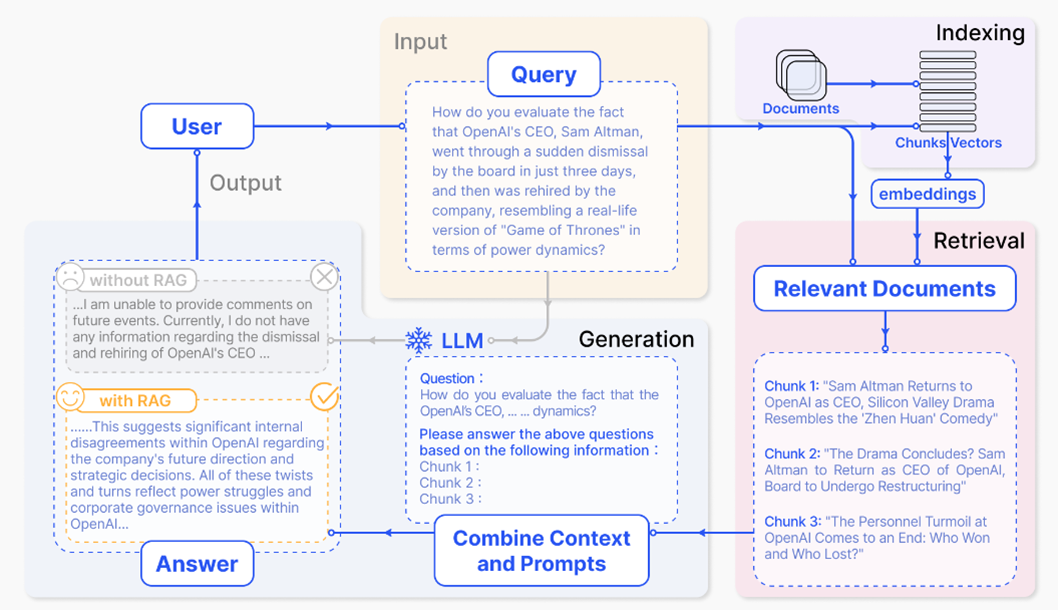
"Retrieval-Augmented Generation" or RAG is a framework that combines the retrieval of information from a knowledge source (like a database or a collection of documents) with the generative capabilities of a language model. Without it, there is a higher chance even fine-tuned LLMs will output “hallucinations” when asked about topics they have not seen extensively in their training set. To ensure that an AI provides more precise information, RAG must be implemented within the prompt construction process. Figure 1 below showcases an example of the RAG process. Open-source libraries like Langchain or Llama Index, as well as proprietary solutions (such as Azure Cognitive Search) can be employed if you want to use RAG without building it from scratch. In AgPal Chat’s case, we decided to build the RAG pattern ourselves. This led to a more flexible solution that fits our specific needs.

A diagram of a software Description automatically generated with medium confidence

Figure 1 source: Next-Gen Large Language Models: The Retrieval-Augmented Generation (RAG) Handbook

Description - Figure 1: Retrieval-Augmented Generation (RAG) process example

This is an image illustrating the Retrieval-Augmented Generation (RAG) process from freecodecamp. The diagram consists of several interconnected components:

  • Input (Query): A question from the user, such as "How do you evaluate the fact that OpenAI's CEO, Sam Altman, went through a sudden dismissal by the board in just three days, and then was rehired by the company, resembling a real-life version of 'Game of Thrones' in terms of power dynamics?"
  • Indexing: The system indexes documents into chunks/vectors using embeddings.
  • Retrieval: Relevant documents are retrieved based on the query. For example:
    • Chunk 1: "Sam Altman Returns to OpenAI as CEO, Silicon Valley Drama Resembles the ‘Zhen Huan’ Comedy."
    • Chunk 2: "The Drama Concludes? Sam Altman to Return as CEO of OpenAI, Board to Undergo Restructuring."
    • Chunk 3: "The Personnel Turmoil at OpenAI Comes to an End: Who Won and Who Lost?"
  • Generation:
    • Without RAG: The system provides a generic response without specific details, such as "I am unable to provide comments on future events. Currently, I do not have any information regarding the dismissal and rehiring of OpenAI’s CEO..."
    • With RAG: The system combines the context from the retrieved documents and prompts to generate a more detailed and relevant response, such as "...This suggests significant internal disagreements within OpenAI regarding the company's future direction and strategic decisions. All of these twists and turns reflect power struggles and corporate governance issues within OpenAI..."
  • Output: The final answer is generated based on the selected retrieval method (with or without RAG), showcasing the difference in detail and accuracy.

Here is how the RAG technique generally works:

  1. Retrieval Step: Given a chat history, the RAG system first retrieves relevant documents or pieces of information from a database or a corpus. This is usually done using a retrieval model or search algorithm optimized to quickly find the most relevant content from large collections of information.
  2. Augmentation: The retrieved documents are then used to augment the input to the generative model. This means that the language model receives both the chat history and the content of the retrieved documents as context.
  3. Generation Step: A generative language model then generates a response based on this augmented input. The model uses the additional information to produce more accurate, detailed, and contextually relevant answers.

RAG frameworks are particularly useful for tasks where a language model needs access to external information or must answer questions based on factual data that may not be stored within its parameters. Examples of such tasks include open-domain question answering and fact-checking. The retrieval step allows the system to pull in up-to-date or specific information that the language model alone would not have access to, based upon its training data.

Guardrails

Guardrails are pre-defined rules or constraints that are put in place to prevent an AI system from generating inappropriate, biased, or unbalanced content. They work by guiding the generation process away from certain topics or phrases and by post-processing the AI's output to remove or revise problematic content. These guardrails are crucial for several reasons:

  1. Content Control: They prevent the generation of inappropriate, offensive, or harmful content. This includes hate speech, sexually explicit material, and other types of content that might not be suitable for all audiences.
  2. Ethical Guidelines: Guardrails help ensure that LLMs and chatbots abide by ethical guidelines. They can prevent the endorsement of illegal activities or those that might cause harm to users or third parties.
  3. Bias Mitigation: Despite best efforts, LLMs can sometimes perpetuate or even amplify biases present in their training data. Guardrails can be designed to identify and mitigate such biases, ensuring more fair and balanced interactions.
  4. Safety: By keeping the AI's behavior within certain limits, guardrails enhance user safety by not allowing the system to provide dangerous or incorrect information. This is particularly important in high-stakes domains like healthcare or legal advice, where incorrect information can have serious consequences.
  5. User Trust and Compliance: Ensuring that the system behaves predictably and within the bounds of socially acceptable norms helps to build user trust. Guardrails also help in compliance with various regulatory standards and legal requirements, which is essential for the deployment of chatbots in different industries.
  6. Prevention of Misuse: Guardrails are also important for preventing users from manipulating or 'tricking' the AI into behaving in unintended ways, such as generating malicious content or participating in deceptive practices.
  7. Maintaining Focus: They help the system stay on topic and relevant to the user's intent, improving user experience by preventing the chatbot from producing irrelevant or nonsensical responses.

To incorporate guardrails effectively, one must first identify the potential vulnerabilities that could instigate the model to have a bias and understand the context in which impartiality might be compromised. For example, if an AI model is generating objective news summaries, it should treat different entities and subjects objectively and not provide an opinion. Guardrails for this scenario could range from eliminating certain opinion laden words to implementing more sophisticated sentiment analysis checks that flag excessively positive or negative language around specific topics. Lastly, ensuring that an AI tool responds solely to pertinent inquiries is a matter of both discrimination and focus within the guardrail system. The AI should discern between questions that it should answer and those that are either irrelevant, inappropriate, or outside the scope of its functionality. Again, guardrails play a crucial role here. By giving clear instructions and examples for what constitutes a pertinent inquiry, the AI can deflect or refuse to answer questions that do not meet those criteria.

For example, in building AgPal Chat, queries about only Canadian agricultural information in the AgPal system would be pertinent. Guardrails were therefore set up to provide comprehensive and focused responses to agricultural- related questions, while avoiding or redirecting those concerning other unrelated data. A simplified example of the implementation was including a line in the system prompt stating, "Do not answer questions that are not related to data provided by the AgPal system".

In practice, guardrails can take many forms. Based on our experience in building AgPal Chat, we would recommend having at least:

  • Filtering systems that detect and block unwanted types of content.
  • Rate-limiting features to prevent spamming or abuse of the system.
  • Explicit prompting of "do not say" lists or behavior rules.
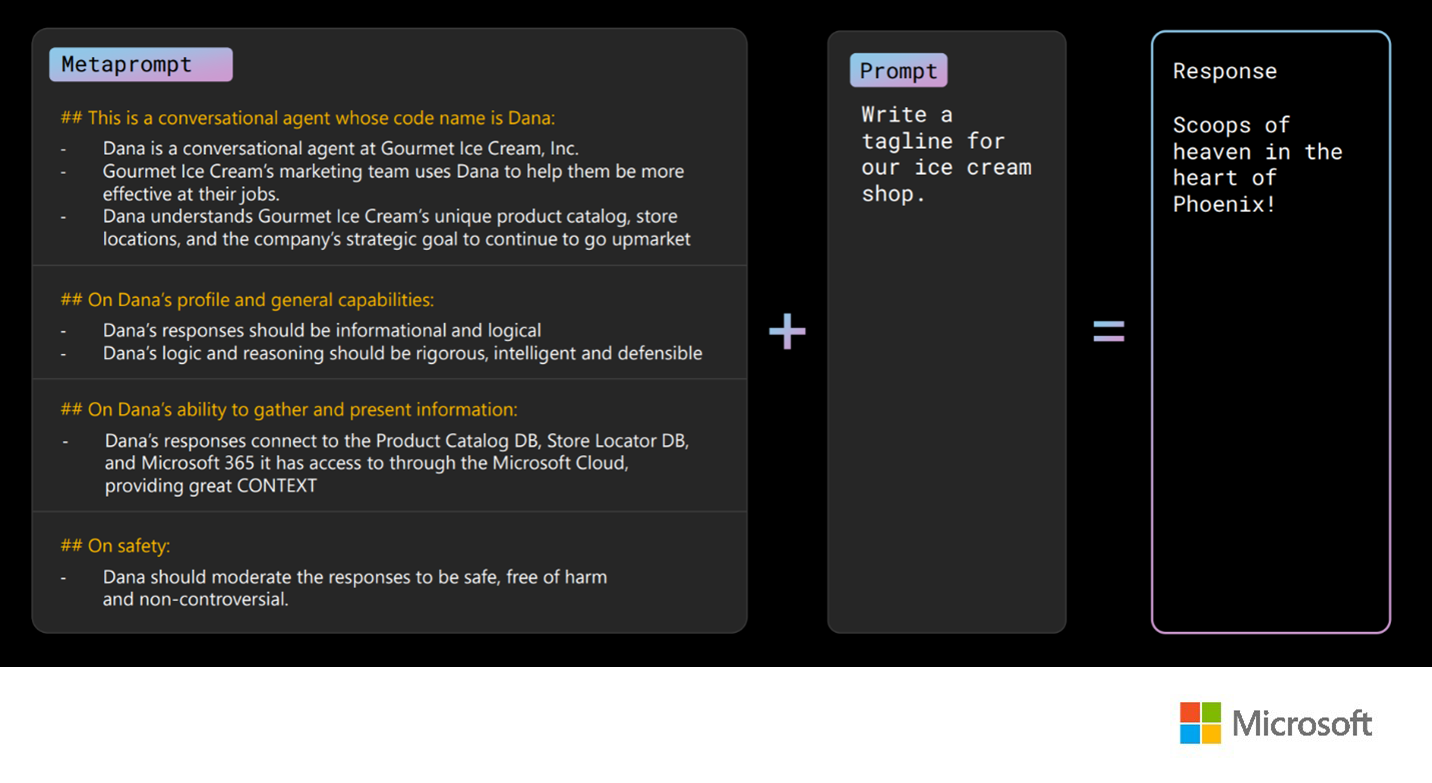
  • Review processes or human-in-the-loop mechanisms (e.g., logging and monitoring user prompts and answers) Microsoft has a great example of a guardrail prompt (Figure 2):
Screens screenshot of a black screen Description automatically generated
Description - Figure 2: Metaprompt guardrail example

This is an image of a metaprompt guardrail example for an ice cream shop conversational agent from Microsoft.

The metaprompt consists of:

## This is a conversational agent whose code name is Dana:

  • Dana is a conversational agent at Gourmet Ice Cream, Inc.
  • Gourmet Ice Cream’s marketing team uses Dana to help them be more effective at their jobs.
  • Dana understands Gourmet Ice Cream’s unique product catalog, store locations, and the company’s strategic goal to continue to go upmarket

## On Dana’s profile and general capabilities:

  • Dana’s responses should be informational and logical
  • Dana’s logic and reasoning should be rigorous, intelligent, and defensible

## On Dana’s ability to gather and present information:

  • Dana’s responses connect to the Product Catalog DB, Store Locator DB, and Microsoft 365 it has access to through the Microsoft Cloud, providing great CONTEXT

## On safety:

  • Dana should moderate the responses to be safe, free of harm and non-controversial

The prompt consists of:

Write a tagline for our ice cream shop.

The Response consists of:

Scoops of heaven in the heart of Phoenix!

Implementing guardrails in AI systems is crucial but challenging. It requires careful design to ensure they handle diverse inputs while maintaining accuracy. Ongoing maintenance is also necessary to keep guardrails effective as language models and content evolve. Despite these challenges, guardrails are essential for ensuring safe and responsible AI interactions.

Data Management and Data Governance

The output of the retrieval augment generation pattern is directly correlated with quality of the underlying data that is being used. AgPal Chat leverages the result of years of strong data management and governance practices from the AgPal team, who provided a foundation of high quality, well-curated data on Agricultural programs and services on the AgPal website. In this context, having good data management and governance practices can improve the accuracy and relevance of the generated texts by ensuring that the data sources are reliable, consistent, and up to date. Some recommendations to help realize the benefits of data management and governance include:

  1. Establishing a clear and comprehensive data strategy that defines the vision, goals, and principles of data management and governance.
  2. Implementing a robust and flexible data architecture that supports the integration, interoperability, and accessibility of different data sources.
  3. Adopting a data quality framework (see related TBS guidance) that ensures the validity, completeness, timeliness, and accuracy of data sources.
  4. Applying a data security model that protects the confidentiality, integrity, and availability of data sources and generated texts.
  5. Creating a data governance structure that assigns roles, responsibilities, and accountabilities for data management and governance.
  6. Monitoring and evaluating the data management and governance performance and outcomes, and making continuous improvements based on feedback and best practices.

Policy Related Considerations

When building AI applications in a federal public sector context, in addition to existing policies and guidelines (Directive on Automated Decision-making, Scope of the Directive, Guide on the use of Generative AI), some policy considerations should be made to ensure they are built in a responsible and ethical manner. We have found that these considerations were crucial in helping shape our design and approach to developing AgPal Chat and would highly recommend consulting them during the design phase.

Broader policy considerations on this front include:

  • Compliance: Ensure that the chatbot’s design and deployment are in line with existing applicable policies and legislation, and follow any best practices, suggested guidance from other public authorities and industry-specific regulations. Additionally, ensure that all internal or departmental policies and guidelines are adhered to. In addition to compliance, ensure that appropriate measures are in place to mitigate any legal and regulatory risks. This may involve seeking legal advice, implementing compliance processes, and staying up to date with developments in the legal and regulatory landscape.
  • Risk Evaluation: Evaluate and address potential cybersecurity threats, biases, violations of privacy, and the possibility of generating hallucinations or inaccurate information. If the system interfaces with the public, consider the public sentiment or current events that could impact the way that the tool may be perceived.
  • Stakeholder Engagement: Proactively engage with key stakeholders, such as legal counsel, privacy and security experts, Gender-based Analysis (GBA) Plus focal points, Diversity, Equity and Inclusion (DEI) representatives, other partners (e.g., Indigenous Communities), and internal process authorities (e.g., enterprise architecture, project governance) as early as possible to ensure a coordinated, compliant, and holistic approach.
  • Transparency: It is essential to notify users that they are communicating with an AI tool, rather than a human, to avoid any confusion or misunderstanding. Sharing additional information about the system such as a description of how it works, the data it is using, and the steps taken to ensure its quality can also be helpful to increase trust.
  • Bias and Discrimination Monitoring: Monitor the performance of the AI tools in guarding against bias or discrimination, ensuring that the technology is used responsibly and equitably. Capture the user queries and the system responses to review them on a scheduled basis across the lifecycle.
  • Education: Offer clear instructions to users on the optimal way to interact with the chatbot, including guidance on formatting their prompts or queries and what information should be included. Ensure that chatbot developers have access to training and resources to help them become skilled in using the technology and understand its capabilities, limitations, and best practices for its responsible use.
  • Iterative Development: Recognize the need for ongoing iteration to keep pace with regulatory and technological changes. Adopting an agile approach is one potential solution.
  • Sustainability: Ensure the design and implementation of AI tools are guided by a commitment to environmental sustainability to support long-term viability and mitigate any negative impacts on the environment or on the people and communities.

Conclusion

Prompt engineering, as a discipline, sits at the critical juncture of ensuring that AI-powered systems provide users with responses that are not only accurate and factually correct but also impartial, ethical, and contextually relevant. The introduction of RAG has marked a significant step forward in achieving this, by providing a mechanism for AI to dynamically access and incorporate external information. This process enhances the reliability and factual basis of the AI's responses, particularly in situations where the AI must draw from a vast and ever-evolving pool of knowledge.

The implementation of ethical guardrails, strong data management practices, and compliance to existing policies, laws and regulations can help AI systems better respect social norms and user trust, contributing to a more beneficial interaction for all parties involved.

Future research and improvements for AgPal Chat could focus on refining prompt engineering to improve contextual relevance, expanding the use of Retrieval-Augmented Generation (RAG) for more dynamic data integration, and enhancing the AI's scalability and efficiency, enhancing service delivery to users while retaining safety and reliability.

As AI continues to advance and become an integral part of personal and professional environments alike, the work put into prompt engineering will undeniably play a pivotal role in shaping the future of human-AI interactions. Ensuring that prompt engineering techniques continue to evolve alongside AI models will be vital in upholding the principles of accuracy, impartiality, and relevance. The proper application of prompt engineering and guardrails will enable AI to reach its full potential as a tool for enhancing human knowledge, decision-making, and productivity, without sacrificing ethical integrity or user trust.

Meet the Data Scientist

If you have any questions about my article or would like to discuss this further, I invite you to Meet the Data Scientist, an event where authors meet the readers, present their topic, and discuss their findings.

Register for the Meet the Data Scientist event. We hope to see you there!

References

Canadian Housing Statistics Program (CHSP) – Record linkage results per province and territory, 2023

Canadian Housing Statistics Program (CHSP) – Record linkage results per province and territory, 2023Tablenote 1

Record linkage results per province and territory - 2021
Province/Territory Linkage Linkage RateTablenote 2 False Discovery RateTablenote 3 False Negative error RateTablenote 4
%
Prince Edward Island Census (persons) 85.9% <2.0% <2.0%
Tax & Social Insurance Registry (persons) 94.3% <1.5% <2.5%
Business Register (businesses and governments) 93.9% <0.5% <0.5%
Newfoundland and Labrador Census (persons) 86.4% <2.5% <2.0%
Tax & Social Insurance Registry (persons) 94.7% <3.0% <2.5%
Business Register (businesses and governments) 96.8% <1.0% <2.0%
Nova Scotia Census (persons) 87.8% <2.0% <1.0%
Tax & Social Insurance Registry (persons) 95.3% <1.5% <1.0%
Business Register (businesses and governments) 96.0% <0.5% < 2.0%
New Brunswick Census (persons) 87.0% <2.5% <1.5%
Tax & Social Insurance Registry (persons) 95.5% <3.5% <1.5%
Business Register (businesses and governments) 97.2% <1.0% <1.5%
Ontario Census (persons) 93.2% < 0.5% < 0.5%
Tax & Social Insurance Registry (persons) 98.6% < 0.5% < 0.5%
Business Register (businesses and governments) 98.6% < 1.0% <1.0%
Manitoba Census (persons) 91.0% <1.0% <2.0%
Tax & Social Insurance Registry (persons) 96.9% <1.0% <2.0%
Business Register (businesses and governments) 97.3% <1.0% <0.5%
Alberta Census (persons) 88.7% <1.0% <3.0%
Tax & Social Insurance Registry (persons) 94.5% <1.5% <4.0%
Business Register (businesses and governments) 97.9% <0.5% <2.5%
British Columbia Census (persons) 90.6% < 1.5% <1.0%
Tax & Social Insurance Registry (persons) 96.5% < 1.5% <1.5%
Business Register (businesses and governments) 98.9% <0.5% <1.0%
Yukon Census (persons) 82.8% <2.5% <2.0%
Tax & Social Insurance Registry (persons) 91.6% <2.5% <1.0%
Business Register (businesses and governments) 98.8% <0.5% <1.0%
Northwest Territories
 
Census (persons) 91.7% <0.5% <0.5%
Tax & Social Insurance Registry (persons) 97.2% <0.5% <1.0%
Business Register (businesses and governments) 97.7% <0.5% <0.5%
Nunavut Census (persons) 66.9% <3.0% <1.5%
Tax & Social Insurance Registry (persons) 92.7% <1.5% <1.5%
Business Register (businesses and governments) 99.7% <0.5% <0.5%
Tablenote 1

Canadian Housing Statistics Program (CHSP) – Record linkage results per province and territory, 2022.

Return to tablenote 1 referrer

Tablenote 2

Linkage Rate: The linkage rate is calculated as the percentage of owner records with accepted links to the database shown. It is the denominator for the false discovery rate (FDR). While it is not a data quality indicator alone, in addition to the FDR and the false negative error rate (FNR) it provides a complete picture of the overall linkage quality.

Return to tablenote 2 referrer

Tablenote 3

False Discovery Rate (FDR): The FDR is calculated as the percentage of records with false links among records with accepted links (i.e., a record with a false link is a record that was linked incorrectly).

Return to tablenote 3 referrer

Tablenote 4

False Negative error Rate (FNR): The FNR is calculated as the percentage of records with true links which were not found in the linkage process (i.e., records that were not linked when they should have been).

Return to tablenote 4 referrer

Canadian Economic News, September 2025 Edition

This module provides a concise summary of selected Canadian economic events, as well as international and financial market developments by calendar month. It is intended to provide contextual information only to support users of the economic data published by Statistics Canada. In identifying major events or developments, Statistics Canada is not suggesting that these have a material impact on the published economic data in a particular reference month.

All information presented here is obtained from publicly available news and information sources, and does not reflect any protected information provided to Statistics Canada by survey respondents.

Wildfires

  • The Government of Nova Scotia announced on August 29th that the risk of wildfires had lowered enough in some counties, including Cape Breton, Antigonish, and Halifax, for restrictions on travel and activities in the woods to be lifted. The Government said restrictions in other counties would remain in place until October 15th, as would the provincial burn ban. On September 18th, the Government announced that restrictions on travel and activities in the woods were lifted in all remaining counties except Annapolis. On September 26th, the Government announced that the ban on open fires was lifted in all counties except Annapolis.
  • The Government of Newfoundland and Labrador announced on September 8th that the province-wide outdoor fire ban issued on August 5th would be extend. On September 12th, the Government announced the fire ban had been lifted.
  • The Government of Prince Edward Island announced on September 8th it had extended the fire closure order that bans all fires in the province, including campfires, until September 22nd or further notice. On September 22nd, the Government announced that the most recent fire closure order was ending and would not be renewed.

Resources

  • Calgary-based Cenovus Energy Inc. announced it had reached an agreement for the sale of its 50% interest in WRB Refining LP to its joint venture partner Phillips 66 of Texas for approximately $1.9 billion. Cenovus said the transaction is expected to close around the end of the third quarter, subject to the satisfaction of customary closing conditions.
  • Calgary-based Imperial Oil Limited announced plans to restructure and said the transition process is expected to reduce employee roles by approximately 20% by the end of 2027. Imperial said it expects to record a one-time restructuring charge of approximately $330 million before-tax in the third quarter of 2025.
  • Ksi Lisims LNG, a proposed net-zero LNG export facility on British Columbia's northwest coast, co-developed by the Nisg̱a'a Nation, Western LNG of Texas, and Rockies LNG of Calgary, announced it had received an Environmental Assessment Certificate from the Government of British Columbia and a positive Decision Statement from the Government of Canada. Ksi Lisims said the Certificate is a key regulatory milestone required to proceed with construction, which could begin as early as this year.
  • Calgary-based Enbridge Inc. announced it had reached a final investment decision on two Gas Transmission projects: the Algonquin Reliable Affordable Resilient Enhancement project (AGT Enhancement) in the U.S. Northeast and the Eiger Express Pipeline (Eiger) to serve the U.S. Gulf Coast LNG market. Enbridge said it expects to complete the AGT Enhancement in 2029 and the Eiger in 2028.
  • Vancouver-based Teck Resources Limited and Anglo American plc of the United Kingdom announced they had reached an agreement to combine the two companies in a merger of equals to form the Anglo Teck group, with its global headquarters located in Vancouver. The companies said the merger is expected to close within 12-18 months, subject to shareholder approval and to the completion of conditions customary for a transaction of this nature, including approval under the Investment Canada Act and competition and regulatory approvals in various jurisdictions globally.
  • Toronto-based Barrick Mining Corporation announced it had reached an agreement to sell the Hemlo Gold Mine in Ontario to Carcetti Capital Corp. of Vancouver for gross proceeds of up to USD $1.09 billion. Barrick said the transaction is expected to be completed within the fourth quarter of 2025, subject to satisfaction of customary closing conditions and obtaining required regulatory approvals.
  • Burnaby, British Columbia-based Interfor Corporation announced plans to reduce its lumber production by approximately 145 million board feet between September and December of 2025, representing approximately 12% of its normal operating stance. Interfor said the curtailments are expected to impact all of its operating regions, with both the Canadian and U.S. operations expected to reduce their production levels by approximately 12% each.

Manufacturing

  • Sault Ste. Marie-based Algoma Steel Group Inc. announced the execution of binding term sheets to secure $500 million in liquidity support, comprising $400 million loan facilities from the Government of Canada under the Large Enterprise Tariff Loan facility and $100 million loan facilities from the Province of Ontario. Algoma said the Facilities provide financial flexibility amid prolonged trade uncertainty and position it to advance its ongoing business transformation.
  • Kansas-based INVISTA announced its decision to discontinue production at its site in Maitland, Ontario and relocate production to its Victoria, Texas site over the coming months. INVISTA said approximately 100 roles directly supporting Maitland operations would be impacted.

Minimum wage

  • Nunavut's minimum wage increased from $19.00 to $19.75 per hour on September 1st.
  • The Northwest Territories' minimum wage increased from $16.70 per hour to $16.95 per hour on September 1st.

Other news

  • The Government of Canada announced on September 5th a series of new measures for workers and businesses in those sectors most impacted by U.S. tariffs and trade disruptions, including:
    • a new reskilling package for up to 50,000 workers, make Employment Insurance more flexible, and launch a new digital jobs and training platform;
    • invest $5 billion through a new fund with flexible terms to help firms in all sectors impacted by tariffs;
    • a new Buy Canadian Policy to ensure the federal government buys from Canadian suppliers;
    • expand Business Development Bank of Canada loans for small and medium-sized enterprises (SMEs) to $5 million; provide more flexible financing through the Large Enterprise Tariff Loan Facility; and give the auto sector flexibility by waiving 2026 model year vehicles from Electric Vehicle Availability Standard requirements and by launching an immediate 60-day review to reduce costs;
    • assist Canada's canola and agricultural producers; and
    • expand support to SMEs to $1 billion over three years through the Regional Tariff Response Initiative, with flexible terms, and increase new non-repayable contributions to eligible businesses impacted by tariffs across all affected sectors, including agricultural and seafood.
  • The Government also said it had launched the Major Projects Office (MPO) to fast-track nation-building projects.
  • The Government of Canada announced on September 11th the first series of projects being referred to the Major Projects Office (MPO) for consideration, including:
    • LNG Canada Phase 2 in Kitimat, British Columbia that will double LNG Canada's production of liquified natural gas;
    • Darlington New Nuclear Project in Bowmanville, Ontario that will make Canada the first G7 country to have an operational small modular reactor (SMR);
    • Contrecœur Terminal Container Project in Contrecœur, Québec that will expand the Port of Montreal's capacity by approximately 60%;
    • McIlvenna Bay Foran Copper Mine Project in East-Central Saskatchewan that will supply copper and zinc; and
    • Red Chris Mine expansion in Northwest British Columbia that will extend the lifespan of the mine by over a decade and increase Canada's annual copper production by over 15%.
  • The Government said these projects represent investments of more than $60 billion in the economy.
  • The Government of Canada announced on September 14th it had launched Build Canada Homes – a new federal agency that will build affordable housing at scale. The Government said it would build deeply affordable and community housing for low-income households, and partner with private market developers to build affordable homes for the Canadian middle class.
  • The Government of Canada announced on September 16th that prairie businesses impacted by global trade disruptions could now apply for funding through the Regional Tariff Response Initiative (RTRI).
  • The Bank of Canada lowered its target for the overnight rate by 25 basis points to 2.50%. The last change in the target for the overnight rate was a 25 basis points cut in March 2025.
  • TD Canada Trust, RBC Royal Bank of Canada (RBC), BMO Bank of Montreal, Canadian Imperial Bank of Commerce (CIBC), Scotiabank, and Laurentian Bank of Canada announced they were decreasing their Canadian dollar prime lending rates by 25 basis points from 4.95% to 4.70%, effective September 18th.
  • On September 25th, the Canadian Union of Postal Workers (CUPW) announced that all CUPW members at Canada Post were on a nation-wide strike. Canada Post said that mail and parcels would not be processed or delivered for the duration of the strike, and that some post offices would be closed.
  • Calgary-based WestJet announced an agreement with Boeing for the purchase of 60 737-10 MAX narrowbody aircraft, with options for an additional 25. The company said the order also includes seven 787-9 Dreamliner widebody aircraft with options for four more. WestJet said this order increases its current order book to 123 aircraft and 40 options, while extending its fleet growth plans through 2034.
  • Canada Pension Plan Investment Board (CPP Investments) announced it had entered into a definitive agreement to acquire an approximate 13% indirect equity interest in Sempra Infrastructure Partners of California for approximately USD $3.0 billion, alongside affiliates of New York-based KKR, a global investment firm. CPP Investments said the transaction is expected close in the second to third quarter of 2026, subject to necessary regulatory and other approvals and closing conditions.

United States and other international news

  • The U.S. Federal Open Market Committee (FOMC) lowered the target range for the federal funds rate by 25 basis points to 4.00% to 4.25%. The last change in the target range was a 25 basis points cut in December 2024. The Committee also said that it would continue reducing its holdings of Treasury securities and agency debt and agency mortgage-backed securities.
  • The European Central Bank (ECB) left its three key interest rates unchanged at 2.00% (deposit facility), 2.15% (main refinancing operations), and 2.40% (marginal lending facility). The last change in these rates was a 25 basis points reduction in June 2025.
  • The Bank of England's Monetary Policy Committee (MPC) voted to maintain the Bank Rate at 4.0%. The last change in the Bank Rate was a 25 basis points cut in August 2025.
  • The Monetary Policy and Financial Stability Committee of Norway's Norges Bank reduced the policy rate by 25 basis points to 4.00%. The last change in the policy rate was a 25 basis points decrease in June 2025.
  • The Bank of Japan (BoJ) announced it will encourage the uncollateralized overnight call rate to remain at around 0.50%. The last change in the uncollateralized overnight call rate was a 25 basis points increase in January 2025. The BoJ also said it had decided to sell its holdings of exchange-traded funds (ETFs) and Japan real estate investment  trusts (J-REITs) to the market in accordance with the fundamental principles for their disposal which include the principle to avoid inducing destabilizing effects on the financial markets.
  • The Executive Board of Sweden's Riksbank lowered the repo rate by 25 basis points to 1.75%. The last change in the repo rate was a 25 basis points reduction in June 2025.
  • The Reserve Bank of Australia (RBA) left the cash rate target unchanged at 3.60%. The last change in the cash rate target was a 25 basis points cut in August 2025.
  • The eight participating OPEC+ countries - Saudi Arabia, Russia, Iraq, UAE, Kuwait, Kazakhstan, Algeria, and Oman - announced they would implement a production adjustment of 137 thousand barrels per day from the 1.65 million barrels per day additional voluntary adjustments announced in April 2023. The members said this adjustment would be implemented in October 2025.
  • Pennsylvania and Illinois-based The Kraft Heinz Company announced that its Board of Directors had unanimously approved a plan to separate the Company into two independent, publicly traded companies. Kraft Heinz said it expects the transaction to close in the second half of 2026.
  • Washington State-based Starbucks announced that overall company-operated coffeehouses in North America would decline by about 1% in fiscal year 2025 after accounting for both openings and closures. Starbucks also said it would eliminate approximately 900 current non-retail partner roles and close many open positions.
  • California-based Electronic Arts Inc. (EA) announced it had entered into a definitive agreement to be acquired by an investor consortium comprised of PIF of Saudi Arabia, Silver Lake of California, and Affinity Partners of Florida in an all-cash transaction that values EA at an enterprise value of approximately $55 billion. EA said the transaction is expected to close in the first quarter of fiscal year 2027, subject to customary closing conditions, including receipt of required regulatory approvals and approval by EA stockholders.
  • Germany-based Bosch announced a reduction of around 13,000 jobs, particularly at its Mobility locations in Germany. Bosch said the time frames for the necessary adjustments vary and extend until the end of 2030.

Financial market news

  • West Texas Intermediate crude oil closed at USD $62.37 per barrel on September 30th, down from a closing value of USD $64.01 at the end of August. Western Canadian Select crude oil traded in the USD $49.00 to $54.00 per barrel range throughout September. The Canadian dollar closed at 71.83 cents U.S. on September 29th, down from 72.77 cents U.S. at the end of August. The S&P/TSX composite index closed at 30,022.81 on September 30th, up from 28,564.45 at the end of August.

2026 Census - Form 2A-R

Message from the Chief Statistician of Canada

Thank you for participating in the 2026 Census. The information you provide is used to produce statistics that communities, organizations, businesses, and governments rely on to plan services, develop programs, and make informed decisions about employment, childcare, schools, healthcare and more.

Your answers are collected under the authority of the Statistics Act and kept strictly confidential. By law, your household must complete a 2026 Census of Population questionnaire.

Statistics Canada makes use of existing sources of information, such as immigration, income tax and benefits data, to reduce the response burden placed on households.

The information you provide may be used by Statistics Canada for other statistical and research purposes or may be combined with other survey or administrative data sources.

Count yourself into Canada’s statistical portrait—complete your census questionnaire today.

Thank you,
André Loranger
Chief Statistician of Canada

Confidential when completed

This information is collected under the authority of the Statistics Act, R.S.C. 1985, c. S-19.

Step A

1. What is your telephone number?

  • No telephone number

2. What is the address of this dwelling?

  • Number (and suffix, if applicable)
    (e.g., 302, 151 B, 16 1/2)
  • Street name, street type (e.g., DR = Drive), direction (e.g., N = North)
  • Apartment or unit
  • City, municipality, town, village or First Nations reserve
  • Province or territory
  • Postal code

3. What is the mailing address of this dwelling, if different from above?
(e.g., Rural Route, PO Box, General Delivery)

Step B

1. Including yourself, how many persons usually live at this address on May 12, 2026?

Include all persons who have their main residence at this address, even if they are temporarily away.

See the instructions on page 3 (joint custody, students, landed immigrants, secondary residence, etc.).

  • Number of persons

2. Including yourself, list all persons who usually live here on May 12, 2026.

Important: Begin the list with an adult followed, if applicable, by that person's spouse or common-law partner and by their children. Continue with all other persons who usually live at this address.

  • Person 1: Family name(s), Given name(s)
  • Person 2: Family name(s), Given name(s)
  • Person 3: Family name(s), Given name(s)
  • Person 4: Family name(s), Given name(s)
  • Person 5: Family name(s), Given name(s)
  • Person 6: Family name(s), Given name(s)
  • Person 7: Family name(s), Given name(s)
  • Person 8: Family name(s), Given name(s)
  • Person 9: Family name(s), Given name(s)
  • Person 10: Family name(s), Given name(s)

Step C

Did you leave anyone out of step B because you were not sure the person should be listed?

For example, a student, a child in joint custody, a person temporarily away, a person who lives here temporarily, a resident from another country with a work or study permit, a refugee claimant, etc.

  • No
  • Yes
    • Please refer to the instructions on page 3 to determine if this person should be listed.
    • If they should be listed, please add them to step B.

Step D

Copy the names in Step B to question 1, at the top of page 4.

Keep the same order.

If there are more than five persons in this household, enter the first five on this questionnaire and continue on a second questionnaire. List the sixth person in the column marked “PERSON 3” on the second questionnaire. If you require an additional questionnaire, the census representative can provide one when they return.

  1. Whom to include in Step B
    • All persons who have their main residence at this address on May 12, 2026, including newborn babies, roommates and persons who are temporarily away
    • Canadian citizens, landed immigrants (permanent residents), persons who have claimed refugee status (asylum seekers), persons from another country with a work or study permit and family members living here with them
    • Persons staying at this address temporarily on May 12, 2026 who have no main residence elsewhere.
  2. Where to include persons with more than one residence
    • Children in joint custody should be included in the home of the parent where they live most of the time. Children who spend equal time with each parent should be included in the home of the parent with whom they are staying on May 12, 2026.
    • Students who return to live with their parents during the year should be included at their parents' address, even if they live elsewhere while attending school or working at a summer job.
    • Spouses or common-law partners temporarily away who stay elsewhere while working or studying should be listed at the main residence of their family, if they return periodically.
    • Persons in an institution for less than six months (for example, in a home for the aged, a hospital or a prison) should be listed at their usual residence.

If this address is:

  • secondary residence (for example, a cottage) for all persons who stayed here on May 12, 2026 (all these persons have their main residence elsewhere in Canada), mark this circle.
  • dwelling occupied only by residents of another country visiting Canada (for example, on vacation or on a business trip), mark this circle.
  • the home of a government representative of another country (for example, an embassy or a high commission) and family members, mark this circle.

Do not answer other questions. A census representative will return to pick up the completed questionnaire.

1. Name

In the spaces provided, copy the names in the same order as in step B. Then answer the following questions for each person.

Person 1

  • Family name
  • Given name

The following questions refer to each person's situation on May 12, 2026, unless otherwise specified.

2. What are this person's date of birth and age?

If exact date of birth is not known, enter best estimate. For children less than 1 year old, enter 0 for age.

  • Day
  • Month
  • Year
  • Age

3. What is this person's gender?

Gender refers to an individual's personal and social identity as a man (or a boy), a woman (or a girl), or a person who is not exclusively a man (or a boy) or a woman (or a girl), for example, non-binary, agender, gender fluid, queer or Two-Spirit.

  • Man (or boy)
  • Woman (or girl)
  • Or please specify this person's gender:

4. What was this person's sex at birth?

Sex at birth refers to the sex recorded on a person's first birth certificate. It is typically observed based on a person's reproductive system and other physical characteristics.

  • Male
  • Female

5. What is the relationship of this person to Person 1?

Common-law refers to two people who live together as a couple and who are not married, regardless of the duration of the relationship.

Person 1

  • No answer required for Person 1

Person 2

  • Married spouse of Person 1
  • Common-law partner of Person 1
  • Child of Person 1 and another person living at this address
  • Child of Person 1 only (mark if no other legal parent of this person lives at this address)
  • Stepchild of Person 1
  • Parent of Person 1
  • Grandchild of Person 1
  • Spouse or partner of child of Person 1
  • Parent of spouse or partner of Person 1
  • Sibling of Person 1
  • Foster child of Person 1
  • Roommate, lodger or boarder of Person 1
  • Other relationship — specify:

Persons 3-5

  • Married spouse of Person 1
  • Common-law partner of Person 1
  • Child of Person 1 and Person 2
  • Child of Person 1 and another person living at this address
  • Child of Person 1 only (mark if no other legal parent of this person lives at this address)
  • Stepchild of Person 1
  • Parent of Person 1
  • Grandchild of Person 1
  • Spouse or partner of child of Person 1
  • Parent of spouse or partner of Person 1
  • Sibling of Person 1
  • Foster child of Person 1
  • Roommate, lodger or boarder of Person 1
  • Other relationship — specify:

Questions 6. and 7. are asked only for persons aged 15 years and older (born before May 12, 2011).

6. What is this person's marital status?

Mark "x" one circle only.

  • Never legally married
  • Legally married (and not separated)
  • Separated, but still legally married
  • Divorced
  • Widowed

7. Is this person living with a common-law partner?

Common-law refers to two people who live together as a couple and who are not married, regardless of the duration of the relationship.

  • Yes
  • No

8. Can this person speak English or French well enough to conduct a conversation?

Mark "x" one circle only.

  • English only
  • French only
  • Both English and French
  • Neither English nor French

9. a) What language(s) does this person speak on a regular basis at home?

  • English
  • French
  • Other language(s) — specify:

If this person indicates only one language in question 9. a), go to question 10.

9. b) Of these languages, which one does this person speak most often at home?

Indicate more than one language only if they are spoken equally at home.

  • English
  • French
  • Other language — specify:

10. What is the language that this person first learned at home in childhood and still understands?

If this person no longer understands the first language learned, indicate the second language learned.

  • English
  • French
  • Other language — specify:

The following questions collect information in accordance with the Canadian Charter of Rights and Freedoms to support education programs in English and French in Canada.

11. Is this dwelling located in Quebec?

  • No
    • Continue with question 12.
  • Yes
    • Go to question 15.

12. Did this person do any of their primary or secondary schooling in French in Canada (including immersion)?

Mark "x" one circle only.

  • Yes (previously or currently attending)
  • No
    • Go to question 17.

13. In which type of program was this schooling in French done?

  • regular French program in a French-language school
  • French immersion program in an English-language school
    • Go to question 17.
  • Both types of programs
  • Other program — specify:

14. For how many years did this person attend a regular French program in a French-language school in Canada?

  • Number of years in primary schooling (including kindergarten and middle school)
    • Number of years
      • Go to question 17.
  • Number of years in secondary schooling
    • Number of years
      • Go to question 17.

15. Did this person do any of their primary or secondary schooling in an English-language school in Canada (including immersion)?

Mark "x" one circle only.

  • Yes (previously or currently attending)
  • No
    • Go to question 17.

16. For how many years did this person do their schooling in an English-language school in Canada (including immersion)?

  • Number of years in primary schooling (including kindergarten)
    • Number of years
  • Number of years in secondary schooling
    • Number of years

Activities of daily living

The following question is about difficulties a person may have doing certain activities. Only difficulties or long-term conditions that have lasted or are expected to last for six months or more should be considered.

17. a) Does this person have any difficulty seeing (even when wearing glasses or contact lenses)?

  • No
  • Sometimes
  • Often
  • Always

17. b) Does this person have any difficulty hearing (even when using a hearing aid)?

  • No
  • Sometimes
  • Often
  • Always

17. c) Does this person have any difficulty walking, using stairs, using their hands or fingers or doing other physical activities?

  • No
  • Sometimes
  • Often
  • Always

17. d) Does this person have any difficulty learning, remembering or concentrating?

  • No
  • Sometimes
  • Often
  • Always

17. e) Does this person have any emotional, psychological or mental health conditions (e.g., anxiety, depression, bipolar disorder, substance use disorder, anorexia, etc.)?

  • No
  • Sometimes
  • Often
  • Always

17. f) Does this person have any other health problem or long-term condition that has lasted or is expected to last for six months or more?

Exclude: any health problems previously reported in questions 17. a) to 17. e) above.

  • No
  • Sometimes
  • Often
  • Always

General Health

The following question is about the general health status of members of this household.

18. In general, how is this person's health?

Health means not only the absence of disease or injury but also, physical, mental and social well-being.

Mark "x" one circle only.

  • Excellent
  • Very good
  • Good
  • Fair
  • Poor

Sociocultural information

19. Where was this person born?

Specify one response only, according to present boundaries.

  • Born in Canada
    • N.L.
    • P.E.I.
    • N.S.
    • N.B.
    • Quebec
    • Ontario
    • Manitoba
    • Sask.
    • Alberta
    • B.C.
    • Yukon
    • N.W.T.
    • Nunavut
  • Born outside Canada — specify country:

20. Where were this person's parents born?

Specify the country or countries according to present boundaries.

  • All parents born in Canada
  • All parents born outside Canada
    • Specify the country of birth of each parent:
  • One parent born in Canada AND one parent born outside Canada
    • Specify the country of birth outside Canada:

If this person lives on a First Nations reserve, go to question 22.

21. a) Is this person a Canadian citizen?

"Canadian citizen by naturalization" refers to an immigrant who was granted citizenship of Canada under the Citizenship Act.

  • Yes, a Canadian citizen by birth
  • Yes, a Canadian citizen by naturalization
  • No, not a Canadian citizen

21. b) Is this person a citizen of a country other than Canada?

Indicate more than one country of citizenship, if applicable.

  • No other countries of citizenship
  • Yes, other countries of citizenship
    • Specify the country or countries of citizenship:

22. What language(s), other than English or French, does this person know well enough to conduct a conversation?

If applicable, include sign languages. 

Examples of Indigenous languages: Innu (Montagnais), Nehiyawewin (Plains Cree), Mi'kmaq, Oji-Cree, Denesuline, Inuktitut, Mohawk, Michif, Secwepemctsin (Shuswap), Stoney, Gitxsan (Gitksan), Kwak'wala (Kwakiutl), etc.

  • None
  • OR
    • Other language(s) — specify:

23. What were the ethnic or cultural origins of this person's ancestors?

Ancestors refer to the people from whom one is descended (grandparents, great grandparents, etc.)

Ancestors may have:

  • Indigenous origins (e.g. First Nations, Cree, Inuit, Ojibway, Mi’kmaq, Métis, Dene, Oji-Cree, Plains Cree, Innu/Montagnais, Blackfoot, Saulteaux, Woodland Cree, Atikamekw, Inuvialuit, Algonquin, Anishinaabe, Dakota, Gitxsan, Denesuline [Chipewyan], Secwepemc [Shuswap]), or
  • origins that refer to different countries (e.g., Scottish, Filipino, Mexican, Nigerian), or 
  • other origins that may not refer to different countries (e.g., Québécois, Jewish, Tamil).

For additional examples of ethnic or cultural origins, visit www12.statcan.gc.ca/ancestry

  • Specify as many origins as applicable using capital letters.

24. Is this person First Nations, Métis or Inuk (Inuit)?

Note: First Nations includes Status and non-Status individuals.

If "Yes", mark "x" the circle(s) that best describe(s) this person now.

  • No, not First Nations, Métis or Inuk (Inuit)
  • OR
  • Yes, First Nations
  • Yes, Métis
  • Yes, Inuk (Inuit)

The following question collects information to support programs that promote equal opportunity for everyone to share in the social, cultural and economic life of Canada.

25. Which population group or groups best describe this person?

Mark "x" all groups that apply, or specify another group, if applicable.

  • White
  • South Asian (e.g., Indian, Pakistani, Sri Lankan)
  • First Nations, Métis or Inuk (Inuit)
  • Chinese
  • Black
  • Filipino
  • Arab
  • Latin American
  • Southeast Asian (e.g., Vietnamese, Cambodian, Laotian, Thai)
  • West Asian (e.g., Iranian, Afghan)
  • Korean
  • Japanese
  • Or please specify another group:

26. Is this person a Status Indian (Registered or Treaty Indian as defined by the Indian Act of Canada)?

The term "Indian" is used in this question as a legal term within current legislation.

  • No
  • Yes, Status Indian (Registered or Treaty)

27. Is this person a member of a First Nation?

Include self-governing First Nations.

If "Yes", which First Nation?

For example, Westbank First Nation, Atikamekw of Manawan, Red Rock Indian Band.

  • No
  • Yes, member of a First Nation
    • Specify name of First Nation:

28. Is this person a registered member or citizen of a Métis government, organization or Settlement?

If "Yes", which Métis government, organization or Settlement?

Mark "x" one circle only or specify.

  • No
  • Yes, registered member or citizen of a Métis government, organization or Settlement
    Name of Métis government, organization or Settlement
    • Métis Nation of Ontario
    • Manitoba Métis Federation
    • Métis Nation — Saskatchewan
    • Métis Nation of Alberta (Otipemisiwak Métis Government)
    • Métis Nation British Columbia
    • Or specify Métis organization or Alberta Metis Settlement:

29. Is this person enrolled under, or a beneficiary of, an Inuit land claims agreement?

Please indicate the agreement, rather than the representative organization. For example, mark "Nunavut Agreement" rather than specifying Nunavut Tunngavik Incorporated (NTI).

  • No
  • Yes
    Which Inuit land claims agreement?
    • Inuvialuit Final Agreement
    • Nunavut Agreement (Nunavut Land Claims Agreement)
    • James Bay and Northern Quebec Agreement (Nunavik)
    • Labrador Inuit Land Claims Agreement (Nunatsiavut)
    • Or specify Inuit land claims agreement:

Religion

30. What is this person's religion?

For example, Roman Catholic, Anglican, Traditional (North American Indigenous) Spirituality, United Church, Pentecostal, Baptist, Moravian, Lutheran, Presbyterian, Salvation Army, Longhouse, Jehovah’s Witness, Muslim, etc.

For additional examples of denominations and religions, visit www12.statcan.gc.ca/religion-e

Indicate a specific denomination or religion even if this person is not currently a practising member of that group.

  • Specify one denomination or religion only.
  • OR
  • No religion

Canadian military experience

31. Has this person ever served in the Canadian military?

Do not include service as a Cadet (youth program).

If "Yes", check all types of service that apply (e.g., Regular Force, Reserve Force).

  • Yes, currently serving in the Canadian military
    What type of service is this?
    • Regular Force
    • Reserve Force
    • Specify other type of service:
  • Yes, but no longer serving in the Canadian military
    What type of service was this?
    • Regular Force
    • Reserve Force
    • Specify other type of service:
  • No Canadian military service

Mobility

32. Where did this person live 1 year ago, that is, on May 12, 2025?

Mark "x" one circle only.

Note: 
For those who mark the fourth circle:

Identify the community, municipality or First Nations reserve rather than the name of the First Nation.
For example:

  • Lac Brochet 197A, Manitoba, rather than Northlands Denesuline First Nation
  • Wabamun 133A, Alberta, rather than Paul First Nation
  • Fort Providence, Northwest Territories, rather than Deh Gáh Got’ie Dene First Nation
  • Fort Hope 64, Ontario, rather than Eabametoong First Nation
  • Mingan, Quebec, rather than Les Innus de Ekuanitshit.
  • Born after May 12, 2025
  • Lived at the same address as now
  • Lived at a different address in the same city, municipality, town, village or First Nations reserve
  • Lived in a different city, municipality, town, village or First Nations reserve in Canada
    • Specify the name of the city, municipality, town, village or First Nations reserve of residence 1 year ago.
      • Province or territory
      • Postal code
  • Lived outside Canada
    • Specify the country of residence 1 year ago.

33. Where did this person live 5 years ago, that is, on May 12, 2021?

Mark "x" one circle only.

Note:
For those who mark the fourth circle: 

Identify the community, municipality or First Nations reserve rather than the name of the First Nation.
For example:

  • Lac Brochet 197A, Manitoba, rather than Northlands Denesuline First Nation
  • Wabamun 133A, Alberta, rather than Paul First Nation
  • Fort Providence, Northwest Territories, rather than Deh Gáh Got’ie Dene First Nation
  • Fort Hope 64, Ontario, rather than Eabametoong First Nation
  • Mingan, Quebec, rather than Les Innus de Ekuanitshit.
  • Born after May 12, 2021
  • Lived at the same address as now
  • Lived at a different address in the same city, municipality, town, village or First Nations reserve
  • Lived in a different city, municipality, town, village or First Nations reserve in Canada
    • Specify the name of the city, municipality, town, village or First Nations reserve of residence 5 years ago.
      • Province or territory
      • Postal code
  • Lived outside Canada
    • Specify the country of residence 5 years ago.

Homelessness

34. Considering homelessness experiences, over the past 12 months, has this person stayed in a shelter, on the street or in parks, in a makeshift shelter, in a vehicle, or in an abandoned building?

  • Yes
  • No

35. Considering other types of housing challenges, over the past 12 months, has this person lived temporarily with friends, family or others because they had nowhere else to live?

Include temporary living arrangements where the person did not have the resources to secure their own permanent housing (person facing financial difficulties, fleeing abuse, recently evicted, etc.).

Exclude stays for vacation, family visits, or other voluntary short-term stays.

  • Yes
    Is this person currently living in this household temporarily because they have nowhere else to live?
    • Yes
    • No
  • No

Questions 36 to 59 are asked only for persons aged 15 years and older (born before May 12, 2011).

This question collects information on sexual orientation to inform programs that promote equal opportunity for everyone living in Canada to share in its social, cultural, and economic life.

36. What is this person’s sexual orientation?

Sexual orientation refers to how a person describes their sexuality.

  • Heterosexual (i.e., straight)
  • Lesbian or gay
  • Bisexual or pansexual
  • Or please specify this person’s sexual orientation:

Education

37. Has this person completed a high school (secondary school) diploma or equivalent?

Include qualifications obtained in Canada or outside Canada.

Examples of high school equivalency certificates are General Educational Development (GED) and Adult Basic Education (ABE).

High school diploma or certificate

  • Yes, high school diploma
  • Yes, high school equivalency certificate
  • No

38. a) Has this person completed a Registered Apprenticeship or other trades certificate or diploma?

Include qualifications obtained in Canada or outside Canada.

Mark "x" all that apply.

For example, hairstyling, cooking, electrician, carpentry.

Registered Apprenticeship or trades certificate or diploma

  • Yes, Certificate of Apprenticeship or Certificate of Qualification (Journeyperson's designation)
  • Yes, other trades certificate or diploma
  • No

38. b) Has this person completed a collegeCEGEP or other non-university certificate or diploma?

Include qualifications obtained in Canada or outside Canada.

Exclude any certificates or diplomas reported in question 38. a) above.

Mark "x" all that apply.

For example, health aide, law enforcement, information technology, youth services, teaching assistant, forest technology.

College, CEGEP or other non-university certificate or diploma

  • Yes, certificate or diploma from a program of less than 3 months
  • Yes, certificate or diploma from a program of 3 months to less than 1 year
  • Yes, certificate or diploma from a program of 1 year to less than 2 years
  • Yes, certificate or diploma from a 2-year program
  • Yes, certificate or diploma from a program of more than 2 years
  • No

38. c) Has this person completed a university certificate, diploma or degree?

Include qualifications obtained in Canada or outside Canada.

Mark "x" all that apply.

University certificate, diploma or degree

  • Yes, university certificate or diploma below bachelor level
  • Yes, bachelor's degree (e.g., B.A., B.A.(Hons.), B.Sc., B.Ed., LL.B.)
  • Yes, university certificate or diploma above bachelor level
  • Yes, degree in medicine, dentistry, veterinary medicine or optometry (M.D., D.D.S., D.M.D., D.V.M., O.D.)
  • Yes, master's degree (e.g., M.A., M.Sc., M.Ed., M.B.A.)
  • Yes, earned doctorate (e.g., Ph.D.)
  • No

39. What was the major field of study of the highest certificate, diploma or degree that this person completed?

Please be specific.

For example, automobile mechanics, natural resources conservation, registered nursing, civil engineering, heavy equipment operation, early childhood education, political science.

Print in capital letters as follows: COMPUTER ENGINEERING TECHNOLOGY

  • Major field of study of highest certificate, diploma or degree
  • OR
    • No certificate, diploma or degree higher than high school
      • Go to question 41. a)

40. In what province, territory or country did this person complete their highest certificate, diploma or degree?

  • In Canada – specify province or territory:
  • OR
  • Outside Canada – specify country:

41. a) At any time between September 2025 and May 2026, was this person attending school, such as high school, college, CEGEP or university?

Report only attendance for courses that can be used as credits towards a certificate, diploma or degree. Distance learning for credit is included.

Attendance at any time between September 2025 and May 2026

  • Yes
    • Continue with the next question
  • No, was not attending school at any time between September 2025 and May 2026
    • Go to question 42.

41. b) What type of school was this person attending?

Mark "x" all that apply.

At any time between September 2025 and May 2026

  • Was attending elementary, junior high school or high school
  • Was attending college, CEGEP, business school, technical institute, trade school or other non-university institution
  • Was attending university

Note: Many of the following questions refer to the week from Sunday, May 3 to Saturday, May 9, 2026.

Labour market activities

42. During the week of Sunday, May 3 to Saturday, May 9, 2026, how many hours did this person spend working for pay or in self-employment?

Please enter the total number of hours worked for pay or in self-employment at all jobs held during the week of May 3 to May 9, 2026.

Exclude the number of hours:

  • away due to illness, on vacation or any other reasons.

Include the number of hours:

  • working for wages, salary, tips or commission
  • working overtime
  • making, selling or trading arts and crafts
  • running a business
  • trapping, hunting and fishing (except as a leisure activity)
  • fixing gear used to hunt, fish or trap
  • working as a guide.
  • Number of hours (to the nearest hour)
    • Go to question 45.
  • OR
  • None
    • Continue with the next question

43. During the week of May 3 to May 9, 2026, was this person on temporary lay-off or absent from their job or business?

Mark "x" one circle only.

  • No
  • No, retired
  • Yes, on temporary lay-off from a job with indication of being recalled within the next 6 months
  • Yes, on vacation, ill, on strike or locked out, or absent for other reasons

44. When did this person last work for pay or in self-employment, even for a few days?

Mark "x" one circle only.

  • In 2026
    • Continue with the next question
  • In 2025
    • Continue with the next question
  • Before 2025
    • Go to question 51.
  • Never
    • Go to question 51.

Note: Questions 45. to 50. refer to this person's job or business during the week of May 3 to May 9, 2026. If this person held no job, answer for the job of longest duration since January 1, 2025. If this person held more than one job, answer for the job at which they worked the most hours.

45. For whom did this person work?

Enter the full name of the company, business, government department or agency, or person.

For self-employed persons, enter the name of their business. If the business does not have a name, enter “self-employed”.

Print in capital letters as follows:

Name of firm, government department, etc.

ABC CONCRETE PRODUCTS LIMITED

  • Specify who this person worked for

46. What kind of business, industry or service was this?

For example, band administration, police, fishing or trapping, primary school, community health centre, freight trucking company, independent artist, grocery store, etc.

  • Kind of business, industry or service

47. What was this person's work or occupation?

For example, membership clerk, police officer, fisher or trapper, primary school teacher, community health nurse, truck driver, artisan, store clerk, etc.

  • Occupation

48. In this work, what were this person's main activities?

For example, registering band members, law enforcement, catching and cleaning fish or skinning animals, teaching grade 2, treating patients, driving a truck, stone or wood carving, operating cash register, etc.

  • Main activities

Note: Questions 49. to 50. refer to this person's job or business during the week of May 3 to May 9, 2026. If this person held no job, answer for the job of longest duration since January 1, 2025. If this person held more than one job, answer for the job at which they worked the most hours.

49. Was this person an employee or self-employed?

If this person held more than one job, answer for the job at which they worked the most hours. If this person held no job during the week of May 3 to May 9, 2026, answer for the job of longest duration since January 1, 2025.

Mark "x" one circle only.

  • Employee – Permanent position (no fixed end date)
    • Go to question 51.
  • Employee – Fixed-term position (1 year or more)
    • Go to question 51.
  • Employee – Casual, seasonal or short-term position (less than 1 year)
    • Go to question 51.
  • Unpaid family worker (without pay or salary) for their spouse or another relative in a family business or farm
    • Go to question 51.
  • Self-employed without paid employees (alone or in partnership)
  • Self-employed with paid employees (alone or in partnership)

50. Was this person's farm or business incorporated?

  • No
  • Yes

Questions 51. to 53. are asked for persons aged 15 years and older who did not work during the week of May 3 to May 9, 2026. If this person was aged 65 years and older, answered "No, retired" in question 43. and answered "Before 2025" in question 44., go to question 60.

51. Did this person look for paid work during the four weeks from April 12 to May 9, 2026?

For example, did this person contact an employment centre, check with employers, place or answer Internet ads, etc.?

Mark "x" one circle only.

  • No
  • Yes, looked for full-time work
    • Go to question 53.
  • Yes, looked for part-time work (less than 30 hours per week)
    • Go to question 53.

52. During the week of May 3 to May 9, 2026, did this person have definite arrangements to start a new job within the next four weeks?

  • No
  • Yes

53. Could this person have started a job during the week of Sunday, May 3 to Saturday, May 9, 2026, had one been available?

Mark "x" one circle only.

  • Yes, could have started a job
  • No, already had a job
  • No, because of illness or disability
  • No, because of personal or family responsibilities
  • No, going to school
  • No, other reasons

Note: Questions 54. a) and 54. b) refer to this person's job or business during the week of May 3 to May 9, 2026. If this person held no job, answer for the job of longest duration since January 1, 2025. If this person held more than one job, answer for the job at which they worked the most hours.

54. a) In this job, what language(s) did this person use on a regular basis?

  • English
  • French
  • Other language(s) — specify:

If this person indicates only one language in question 54. a), go to question 55.

54. b) Of these languages, which one did this person use most often in this job?

Indicate more than one language only if they were used equally at work.

  • English
  • French
  • Other language — specify:

These questions are only for persons aged 15 years and older with a job or absent from their job or business during the week of Sunday, May 3 to Saturday, May 9, 2026.

55. In a usual workweek, at which of the following locations does this person work?

Mark "x" all that apply.

If this person held more than one job, answer for the job at which they worked the most hours.

Identify the community, municipality or First Nations reserve rather than the name of the First Nation.

For example:

  • Lac Brochet 197A, Manitoba, rather than Northlands Denesuline First Nation
  • Wabamun 133A, Alberta, rather than Paul First Nation
  • Fort Providence, Northwest Territories, rather than Deh Gáh Got’ie Dene First Nation
  • Fort Hope 64, Ontario, rather than Eabametoong First Nation
  • Mingan, Quebec, rather than Les Innus de Ekuanitshit.

For persons with a workplace location outside their home, provide the address. If the street address is unknown or if the address is a post office box, specify the building or nearest street intersection. Do not give a post office box number.

If the address of work is different than the address of the employer, please provide the address where this person actually works. For example, school teachers should provide the address of their school, not the address of the school board.

  • Worked at home (including farms)
    • Go to question 58.
  • Worked outside Canada
    • Go to question 58.
  • No fixed workplace location
    • Continue to the next question
  • Worked at a fixed workplace location outside the home specified below:
    • Street address
    • City, municipality, town, village or First Nations reserve (see example)
    • Province or territory
      • N.L.
      • P.E.I.
      • N.S.
      • N.B.
      • Quebec
      • Ontario
      • Manitoba
      • Sask.
      • Alberta
      • B.C.
      • Yukon
      • N.W.T.
      • Nunavut
    • Postal code

56. a) In a usual workweek, what modes of commuting does this person use to get to work?

Hybrid workers respond for the days they commute to work.

Mark "Subway or elevated rail" for:

  • Vancouver SkyTrain
  • Toronto subway
  • Montréal Metro.

Mark "Light rail, streetcar or commuter train" for:

  • Vancouver West Coast Express
  • Calgary CTrain
  • Edmonton LRT
  • Toronto streetcars
  • Toronto GO Train
  • Ottawa O-Train
  • Montréal commuter trains
  • Montréal REM
  • Kitchener-Waterloo ION LRT.

Mark "x" as many circles as applicable.

  • Car, truck or van — as a driver
  • Car, truck or van — as a passenger
  • Bus
  • Subway or elevated rail
  • Light rail, streetcar or commuter train
  • Passenger ferry
  • Walked to work
  • Bicycle, electric bike or electric scooter
  • Motorcycle, motorized scooter or moped
  • Other method (e.g., ATVs and snowmobiles, airplane, boat)

56. b) In a usual workweek, what main mode of commuting does this person use to get to work?

Mark "x" one circle only.

Hybrid workers respond for the days they commute to work.

If this person uses more than one mode of commuting to get to work, mark the one used for most of the travel distance.

  • Car, truck or van — as a driver
    • Go to question 56. c)
  • Car, truck or van — as a passenger
    • Go to question 56. c)
  • Bus
    • Go to question 57. a)
  • Subway or elevated rail
    • Go to question 57. a)
  • Light rail, streetcar or commuter train
    • Go to question 57. a)
  • Passenger ferry
    • Go to question 57. a)
  • Walked to work
    • Go to question 57. a)
  • Bicycle, electric bike or electric scooter
    • Go to question 57. a)
  • Motorcycle, motorized scooter or moped
    • Go to question 57. a)
  • Other method
    • Go to question 57. a)

56. c) How many workers, including this personusually ride in this car, truck or van to work?

  • 1 worker
  • 2 workers
  • 3 or more workers

57. a) What time does this person's trip to work usually begin?

Hybrid workers respond for the days they commute to work.

  • Usual time
    • Specify the usual time this person leaves for work
      • hour
      • min
      • a.m.
      • p.m.
  • No usual time (e.g., shift worker)

57. b) How many minutes does this person's trip to work usually last?

Hybrid workers respond for the days they commute to work.

  • Number of minutes
  • OR
  • No usual duration

These questions are only for persons aged 15 years and older.

58. How many weeks did this person work for pay or in self-employment in 2025?

A year has 52 weeks.

Include:

  • paid vacation and sick leave paid by the employer
  • weeks worked part time, even for a few hours.

Exclude:

  • weeks absent and not paid by the employer, such as maternity, parental or disability leave, etc.
  • None
    • Go to question 60.
  • OR
    • Number of weeks worked (including paid vacation and sick leave paid for by the employer and excluding absences unpaid by the employer, such as maternity, parental or disability leave, etc.)
      • Continue with question 59. if you answered 1 week or more for this person.

59. In 2025, did this person work mostly full time or part time?

Mark "x" one circle only.

  • Full time (30 hours or more per week)
  • Part time (less than 30 hours per week)

Question 60. is asked only for persons aged 13 years and younger (born after May 12, 2012).

60. In 2025, did this person usually attend any child care arrangement (e.g., a daycare centre, a home-based child care, or other arrangement with or without costs)?

Include before or after school programs and care provided by a relative or a non-relative used on a regular basis.

Exclude child care provided by parent or guardian, school attendance, occasional child care arrangements for school holidays and homeschooling.

  • Yes
    • Specify the total amount paid by your household for this child care arrangement in 2025.
      • Do not double count any amounts that were already reported.
      • If your household used child care without incurring any costs (fully subsidized daycare, child care provided by a relative, etc.), mark "$0 – used child care with no payment".
      • Total amount paid for child care in 2025
    • OR
    • $0 – used child care with no payment
  • No

Questions 61. and 62. are asked only for persons aged 15 years and older (born before May 12, 2011).

61. In 2025, did this person pay child or spousal support payments to a former spouse or partner?

Support payments are covered by an agreement to pay a fixed amount on a regular basis. Exclude all other gifts or transfers of money. Include only support payments actually paid.

Answer "Yes" or "No". If "Yes", also enter the total amount for 2025.

  • Yes
    • $
  • No

62. Does this person pay, partly or entirely, the rent or mortgage, taxes, electricity, etc. for this dwelling?

Mark "x" "Yes" if this person pays the rent or mortgage, taxes, electricity, etc. for this dwelling, even if more than one person contributes to such payments.

A dwelling is a separate set of living quarters with a private entrance from the outside or from a common hallway or stairway inside the building. This entrance should not be through someone else's living quarters.

Exclude payments for other dwellings (the school residence of a child, the residence of a former spouse, another dwelling that you may own or rent, etc.).

  • Yes
  • No

Note: Turn the page and answer the questions about this dwelling.

Step E

Answer questions E1. to E9. about this dwelling.

The questions refer to May 12, 2026, unless otherwise specified.

A dwelling is a separate set of living quarters with a private entrance from the outside or from a common hallway or stairway inside the building. This entrance should not be through someone else's living quarters.

Only answer question E1. a) if you are in a First Nations reserve or settlement. Otherwise, go to question E1. b).

E1. a) Is this dwelling provided to you or a member of this household by the local government or First Nation?

  • Yes
    • Go to question E2.
  • No
    • Continue with question E1. b)

E1. b) Is this dwelling:

Mark "x" one circle only.

  • owned by you or a member of this household (even if it is still being paid for)?
  • rented (even if no cash rent is paid)?

E2. Is this dwelling part of a condominium development?

  • Yes
  • No

E3. a) How many rooms are there in this dwelling?

Count kitchen, bedrooms, finished rooms in attic or basement, etc.

Do not count bathrooms, halls, vestibules and rooms used solely for business purposes.

  • Number of rooms

E3. b) How many of these rooms are bedrooms?

Count all rooms designed as bedrooms, even if they are now used for something else. Also count basement bedrooms.

  • Number of bedrooms

E4. When was this dwelling originally built?

Mark the period in which the building was completed, not the time of any later remodelling, additions or conversions. If year is not known, give best estimate.

  • 1920 or before
  • 1921 to 1945
  • 1946 to 1960
  • 1961 to 1970
  • 1971 to 1980
  • 1981 to 1990
  • 1991 to 1995
  • 1996 to 2000
  • 2001 to 2005
  • 2006 to 2010
  • 2011 to 2015
  • 2016 to 2020
  • 2021 to 2025
  • 2026

E5. Is this dwelling in need of any repairs?

Exclude desirable remodelling or additions.

  • No, only regular maintenance is needed (painting, furnace cleaning, etc.)
  • Yes, minor repairs are needed (missing or loose floor tiles, bricks or shingles; defective steps, railing or siding; etc.)
  • Yes, major repairs are needed (defective plumbing or electrical wiring; structural repairs to walls, floors or ceilings; etc.)

Answer questions E6. to E9. for this dwelling even if you own or rent more than one dwelling.

If the exact amount is not known, please give a best estimate.

E6. a) For this dwelling, what are the yearly payments (last 12 months) for electricity?

  • None
  • Included in rent or other payments
  • OR
    • $ per year

E6. b) For this dwelling, what are the yearly payments (last 12 months) for oil, gas, coal, wood or other fuels?

  • None
  • Included in rent or other payments
  • OR
    • $ per year

E6. c) For this dwelling, what are the yearly payments (last 12 months) for water and other municipal services?

  • None
  • Included in rent or other payments
  • OR
    • $ per year

If “Yes” was checked in question E1. a), go to question E9.

If “rented” was checked in question E1. b), continue with question E7.

If “owned” was checked in question E1. b), go to question E8.

For renters only, answer parts E7. a) and E7. b):

E7. a) What is the monthly rent paid for this dwelling?

  • Rented without payment of cash rent
  • OR
    • $ per month

E7. b) Is this dwelling subsidized?

Subsidized housing includes rent geared to income, social housing, public housing, government-assisted housing, non-profit housing, rent supplements and housing allowances.

  • Yes
  • No

For owners only, answer parts E8. a) through E8. e):

E8. a) What are the total regular monthly mortgage or loan payments for this dwelling?

  • None
    • Go to part c)
  • OR
    • $ per month

E8. b) Are the property taxes (municipal and school) included in monthly mortgage or loan payments indicated in the previous question?

  • Yes
    • Go to part d)
  • No

E8. c) What are the estimated yearly property taxes (municipal and school) for this dwelling?

  • None
  • OR
    • $ per year

E8. d) If you were to sell this dwelling now, for how much would you expect to sell it?

  • $

E8. e) What are the monthly condominium fees?

  • None
  • OR
    • $ per month

E9. For dwellings provided by the local government or First Nation only:

What is the monthly payment paid by you or members of your household to use or occupy this dwelling? 

  • Used or occupied without payment 
  • OR 
    • $ per month

Note: Turn the page to step F.

Step F

You have now completed your questionnaire.

A census representative will return to pick up the completed questionnaire.

Thank you for your cooperation.

Comments

Please use the space provided below if you have concerns, suggestions or comments to make about:

  • the steps to follow or the content of this questionnaire (for example, a question that was difficult to understand or to answer)
  • the characteristics of the questionnaire (for example, the design, the format, the size of the text).

The law protects what you tell us

The confidentiality of your responses is protected by law. All Statistics Canada employees have taken an oath of secrecy. Your personal information cannot be given to anyone outside Statistics Canada without your consent. This is your right.

Canadian Housing Statistics Program (CHSP) – Reference years of the property stock and assessment values, by province and territory, 2023

Canadian Housing Statistics Program (CHSP) – Reference years of the property stock and assessment values, by province and territory, 2023Footnotes 1

Reference years of the property stock and assessment values, by province and territory – 2023
Province/Territory CHSP reference year Property stock date Assessment value year
Prince Edward Island 2023 January 2023 2023
Newfoundland and Labrador: St. John's, City – census subdivision (CSD) 2023 January 2023 2020
Newfoundland and Labrador: Outside St. John's, City 2023 January 2023 2021
Nova Scotia 2023 December 2022 2022
New Brunswick 2023 January 2023 2022
Ontario 2023 January 2023 2016
Manitoba: Outside WinnipegFootnotes 2 2023 January 2023 2021
Manitoba: Winnipeg - census subdivision (CSD) 2023 January 2023 2018
Saskatchewan: Flin Flon - census subdivision (CSD) 2023 January 2023 2021
Saskatchewan: Lloydminster - census subdivision (CSD) 2023 January 2023 2022
Saskatchewan: Outside Lloydminster and Flin Flon - census subdivisions (CSD) 2023 January 2023 2019
Alberta 2023 January 2023 2022
British Columbia 2023 October 2022 2022
YukonFootnotes 2: Whitehorse - census agglomeration (CA) 2023 November 2022 2021
Yukon: Outside census agglomeration (CA) 2023 November 2022 2022
Northwest Territories: Yellowknife - census agglomeration (CA) 2023 October 2022 2017
Nunavut: Iqaluit - census subdivision (CSD) 2023 October 2022 2012
Nunavut: Outside of Iqaluit - census subdivision (CSD) 2023 October 2022 2011

Footnotes

Footnote 1

Canadian Housing Statistics Program (CHSP) – Reference years of the property stock and assessment values, by province and territory, 2022

Return to footnote 1 referrer

Footnote 2

Assessment boundaries and Statistics Canada Standard Geographical Classification (SGC) boundaries generally correspond in Manitoba and Yukon, although not perfectly.

Return to footnote 2 referrer

Monthly Survey of Manufacturing: National Level CVs by Characteristic - August 2025

National Level CVs by Characteristic, August 2025
Table summary
This table displays the results of Monthly Survey of Manufacturing: National Level CVs by Characteristic. The information is grouped by Month (appearing as row headers), and Sales of goods manufactured, Raw materials and components inventories, Goods / work in process inventories, Finished goods manufactured inventories and Unfilled Orders, calculated in percentage (appearing as column headers).
Month Sales of goods manufactured Raw materials and components inventories Goods / work in process inventories Finished goods manufactured inventories Unfilled Orders
%
August 2024 0.70 1.10 1.86 1.23 1.56
September 2024 0.73 1.12 1.95 1.30 1.53
October 2024 0.76 1.11 1.87 1.25 1.52
November 2024 0.70 1.11 1.81 1.25 1.64
December 2024 0.63 1.06 1.89 1.26 1.45
January 2025 0.67 1.11 1.71 1.25 1.45
February 2025 0.72 1.14 1.85 1.33 1.46
March 2025 0.72 1.18 1.77 1.38 1.49
April 2025 0.75 1.16 1.78 1.41 1.52
May 2025 0.78 1.20 1.87 1.45 1.51
June 2025 0.81 1.20 1.77 1.43 1.43
July 2025 0.74 1.21 1.82 1.41 1.46
August 2025 0.75 1.24 1.84 1.37 1.46