Invitation to participate in the revision of the North American Industry Classification System (NAICS) Canada

Opened: August 2023

Introduction

Statistics Canada invites data producers and data users, representatives of business associations, government bodies at the federal, provincial and local levels, academics and researchers and all other interested parties to submit proposals for the revision to the North American Industry Classification System (NAICS) Canada.

Following the decision of the Statistics Canada's Economic Standards Steering Committee (ESSC) on April 28, 2023 to institute a permanent consultation process for NAICS Canada, proposals for changes to NAICS Canada may be submitted and reviewed on an ongoing basis. Only a cut-off date for considering proposed changes to be included into a new version of NAICS Canada will be instituted moving forward. For example, for NAICS Canada 2027, the deadline for changes to be included has been set to the end of June 2025. For revisions beyond 2027, such a cut-off date will be maintained at about one year and half prior to the release date of the new classification version based on the 5-year revision cycle.

As was done with NAICS Canada 2017 (2 updates), in exceptional circumstances, when a consensus is reached among the data producers and users at Statistics Canada, the classification might be revised before the regular revision cycle of 5-years, as the way of 'evergreening' of the standard.

In the context of statistical classifications, evergreening refers to updating the classification and the related reference (index) file on a continuous basis with the objective of maintaining timeliness and relevance. Though, evergreening does not necessary result in the release of a new version of the classification every year. A decision to release a new version (before the end of the regular 5 years revision cycle) needs to be discussed and assessed by key classification stewards considering potential impacts on data and statistical programs.

Objectives

We are seeking proposals for changes for two main reasons:

  • collect input from data producers and users as an integral part of the NAICS revision process, and
  • ensure users' needs continue to be met, therefore the classification remains relevant.

Background

The North American Industry Classification System was released for the first time in 1997, with NAICS 1997. This classification was developed through the cooperation of Statistics Canada, Mexico's Instituto Nacional de Estadistica y Geografia (INEGI) and the Economic Classification Policy Committee (ECPC) of the United States. Each country maintains its own version of NAICS (NAICS Canada, NAICS U.S., and NAICS Mexico). The three country versions are generally the same with some differences found primarily in wholesale trade, retail trade and government, and at the 6-digit national industry level.

NAICS replaced the existing industry classification system used in Canada, which was the Standard Industrial Classification (SIC). Since then, NAICS Canada, U.S. and Mexico have been revised on a 5-year cycle in 2002, 2007, 2012, 2017 and 2022. The three NAICS partner agencies meet regularly to discuss possible changes to the common NAICS structure.

Canada has adopted a permanent "evergreen" practice with regards to NAICS, which means the updating of NAICS Canada on an as-needed basis, with version updates between the standard 5-year revision milestones, usually to adapt to exceptional circumstances if structural changes are approved. In fact, these "evergreen" updates strive to be constrained to specific situations or cases, e.g., in the cases of NAICS Canada 2017 Version 2.0 where changes were made to Internet publishing activities and NAICS Canada 2017 Version 3.0 where the classification was revised to account for new industries created after Canada has adopted a new law legalizing cannabis for non-medical use with impacts on the whole Canadian economy and society. These changes were approved based on a consensus following demands from data producers and users at Statistics Canada and externally. The intent remains to minimize revisions of the structure of NAICS between revision cycles, as we are trying to strike a balance between having a timely or relevant classification and maintaining historical data series, in particular from a National Accounts perspective.

We will continue to look at the best way to communicate to the public about revisions not affecting the structure or scope of NAICS categories between revision cycles (e.g., adding new activities to help for coding or identification of their placement in the classification, clarifying the texts/explanatory notes, etc.).

Nature and content of proposals

Respondents are invited to provide their comments, feedback, and suggestions on how to improve the NAICS content. They must outline their rationale for proposed changes.

No restrictions have been placed on content. Respondents may propose virtual (not affecting the meaning of a classification item) and real changes (affecting the meaning of a classification item, whether or not accompanied by changes in naming and/or coding). Examples of real changes, those that affect the scope of the classification items or categories (with or without a change in the codes), are: the creation of new classification items, the combination or decomposition of classification items, as well as the elimination of classification items. A classification item (sometimes referred to as a "class") represents a category at a certain level within a statistical classification structure. It defines the content and the borders of the category, and generally contains a code, title, definition/description, as well as exclusions where necessary. For NAICS, classifications items are: Sectors (2-digit), Subsectors (3-digit), Industry group (4-digit) and Industry (5-digit), and Canadian industry (6-digit).

Key dates for NAICS Canada 2027 revision process

Here are key dates for the NAICS Canada 2027 revision process:

  • Official public consultation period for changes proposed for inclusion in NAICS Canada 2027: Ongoing to the end of June 2025. Beyond 2027, the cut-off date to incorporate approved changes from proposals into the new classification version will be around a year and half before the release date of the next version of NAICS Canada based on the 5-year revision cycle.
  • Completion of trilateral negotiations: September 2025.
  • Public notice containing proposals in consideration for changes in NAICS Canada: November 2025.
  • Public notice containing the final approved proposal for changes in NAICS Canada: February 2026.
  • Public release of NAICS Canada 2027 Version 1.0: January 2027.

The next revised version of NAICS Canada will be called NAICS Canada 2027 Version 1.0.

Individuals and organizations wishing to submit proposals for changes in NAICS Canada may do so at any time, in accordance with the permanent consultation process adopted by Statistics Canada with regards to NAICS Canada.

Submitting Proposals

Proposals for NAICS Canada revisions must contain the contact information of those submitting the change request:

  1. Name
  2. Organization (when an individual is proposing changes on behalf of an organization)
  3. Mailing address
  4. Email address
  5. Phone number

Should additional information or clarification to the proposal be required, participants might be contacted.

Proposals must be submitted by email to statcan.naics-consultation-scian-consultation.statcan@statcan.gc.ca.

Consultation guidelines for submitting proposals for change in NAICS Canada

Individuals or organizations are encouraged to follow the guidelines below when developing their proposals.

Proposals should:

  • clearly identify the proposed addition or change to NAICS; this can include the creation of entirely new classes, or modifications to existing classes;
  • outline the rationale and include supporting information for the proposed change;
  • if possible, describe the empirical significance (i.e. revenue, expenses, value-added, employment) of proposed changes, and especially changes affecting the scope of existing classification items/categories;
  • new industries could be subjected to tests of empirical significance with respect to revenue, value added, employment, and number of establishments;
  • be consistent with classification principles (e.g., mutual exclusivity, exhaustiveness, and homogeneity within categories)
  • be relevant, that is
    • describe the present analytical interest;
    • enhance the usefulness of data;
    • base the proposal on appropriate statistical research or subject matter expertise.

Please consider the questions below when preparing your input for the consultation on the revision of NAICS Canada:

  • Are there socioeconomic activities for which you cannot find a satisfactory NAICS code?
  • Are there classification items that you find difficult to use because their descriptions are vague or unclear?
  • Are there pairs of classification items you find difficult to distinguish from each other? Are there boundaries that could be clarified?
  • Are there socioeconomic activities that you think should have their own NAICS category? Please indicate at which level and why, with the support documentation about the activities (see guidelines above for a proposal).
  • Are there activities that you are able to locate in NAICS, but you would like to have them located in a different sector or industry?
  • Is the language or terminology used in NAICS in need of updating to be consistent with current usage?

Note that submissions do not need to cover every topic; you can submit your comments on your particular area(s) of concern only.

The following criteria will be used to review the proposals received:

  • consistency with classification principles such as mutual exclusivity, exhaustiveness, and homogeneity of activities and output (products) within categories;
  • have empirical significance as an industry
  • data be collectable and publishable;
  • proposal can be linked to a funded program for data collection;
  • be relevant, that is, it must be of analytical interest, result in data useful to users, and be based on appropriate statistical research and subject-matter expertise;
  • be consistent with the Canadian System of National Accounts;
  • special attention will be given to specific industries, including:
    • new or emerging activities
    • activities related to new production processes.

NAICS Classification Structure

NAICS has a 6-digit, 5-level classification structure, consisting of 2-digit sectors, 3-digit sub-sectors, 4-digit industry groups, 5-digit industries and 6-digit national industries. Changes may be proposed for any level, but changes to the 2-digit to 5-digit levels will be subject to trilateral negotiation and approval. Changes to the 6-digit national industry level are at the discretion of each trilateral partner (i.e., Statistics Canada makes the final decision about changes to 6-digit industries in NAICS Canada).

North American Industry Classification System (NAICS) Canada 2022 Version 1.0 is the latest version of the classification for the participants of this consultation to base their input on. In the context of a permanent consultation process, persons or organizations proposing a change should always make sure they refer to the latest available version of NAICS Canada.

Costs associated with proposals

Statistics Canada will not reimburse respondents for expenses incurred in developing their proposal.

Treatment of proposals

Statistics Canada will review all proposals received. Statistics Canada reserves the right to use independent consultants or government employees, if deemed necessary, to assess proposals.

If deemed appropriate, a representative of Statistics Canada will contact respondents to ask additional questions or seek clarification on a particular aspect of their proposal.

Please note that a proposal will not necessarily result in changes to NAICS Canada.

Official languages

Proposals may be written in either of Canada's official languages – English or French.

Confidentiality

Statistics Canada is committed to respecting the privacy of consultation participants. All personal information created, held or collected by the Agency is protected by the Privacy Act. For more information on Statistics Canada's privacy policies, please consult the Privacy notice.

Thank You

We thank all participants for their continued interest and participation in the various NAICS engagement activities.

Enquiries

If you have any enquiries about this process, please send them to statcan.naics-consultation-scian-consultation.statcan@statcan.gc.ca.

National Travel Survey: C.V.s for Visit-Expenditures by Duration of Visit, Main Trip Purpose and Country or Region of Expenditures - Q1 2023

National Travel Survey: C.V.s for Visit-Expenditures by Duration of Visit, Main Trip Purpose and Country or Region of Expenditures, including expenditures at origin and those for air commercial transportation in Canada, in Thousands of Dollars (x 1,000)
Table summary
This table displays the results of C.V.s for Visit-Expenditures by Duration of Visit, Main Trip Purpose and Country or Region of Expenditures. The information is grouped by Duration of trip (appearing as row headers), Main Trip Purpose, Country or Region of Expenditures (Total, Canada, United States, Overseas) calculated using Visit-Expenditures in Thousands of Dollars (x 1,000) and c.v. as units of measure (appearing as column headers).
Duration of Visit Main Trip Purpose Country or Region of Expenditures
Total Canada United States Overseas
$ '000 C.V. $ '000 C.V. $ '000 C.V. $ '000 C.V.
Total Duration Total Main Trip Purpose 25,986,818 A 13,651,796 B 7,448,832 A 4,886,190 B
Holiday, leisure or recreation 14,369,721 A 5,582,368 A 5,150,065 A 3,637,288 B
Visit friends or relatives 5,499,091 B 3,902,696 C 800,488 B 795,907 B
Personal conference, convention or trade show 324,357 D 180,423 E 140,837 E 3,097 E
Shopping, non-routine 939,437 B 799,606 B 138,268 C 1,563 E
Other personal reasons 1,341,669 B 989,375 B 198,094 E 154,200 E
Business conference, convention or trade show 1,621,677 B 775,981 B 713,914 C 131,781 C
Other business 1,890,866 D 1,421,347 E 307,164 C 162,354 D
Same-Day Total Main Trip Purpose 5,200,264 B 4,834,771 B 331,748 C 33,745 D
Holiday, leisure or recreation 1,874,279 B 1,691,506 B 151,225 C 31,547 D
Visit friends or relatives 1,473,322 D 1,431,362 E 41,960 E ..  
Personal conference, convention or trade show 52,443 C 50,447 C 1,996 E ..  
Shopping, non-routine 823,829 B 723,496 B 100,333 C ..  
Other personal reasons 476,644 B 457,469 B 16,977 E 2,198 E
Business conference, convention or trade show 73,296 D 68,329 D 4,967 E ..  
Other business 426,451 E 412,162 E 14,290 E ..  
Overnight Total Main Trip Purpose 20,786,554 A 8,817,025 B 7,117,084 A 4,852,445 B
Holiday, leisure or recreation 12,495,442 A 3,890,862 A 4,998,840 B 3,605,741 B
Visit friends or relatives 4,025,769 B 2,471,334 B 758,527 B 795,907 B
Personal conference, convention or trade show 271,914 E 129,976 E 138,841 E 3,097 E
Shopping, non-routine 115,607 C 76,109 D 37,935 E 1,563 E
Other personal reasons 865,025 B 531,906 B 181,117 E 152,002 E
Business conference, convention or trade show 1,548,381 B 707,652 B 708,948 C 131,781 C
Other business 1,464,415 C 1,009,185 C 292,875 C 162,354 D
..
data not available

Estimates contained in this table have been assigned a letter to indicate their coefficient of variation (c.v.) (expressed as a percentage). The letter grades represent the following coefficients of variation:

A
c.v. between or equal to 0.00% and 5.00% and means Excellent.
B
c.v. between or equal to 5.01% and 15.00% and means Very good.
C
c.v. between or equal to 15.01% and 25.00% and means Good.
D
c.v. between or equal to 25.01% and 35.00% and means Acceptable.
E
c.v. greater than 35.00% and means Use with caution.

National Travel Survey: C.V.s for Person-Trips by Duration of Trip, Main Trip Purpose and Country or Region of Trip Destination - Q1 2023

National Travel Survey: C.V.s for Person-Trips by Duration of Trip, Main Trip Purpose and Country or Region of Trip Destination, Q1 2023
Table summary
This table displays the results of C.V.s for Person-Trips by Duration of Trip, Main Trip Purpose and Country or Region of Trip Destination. The information is grouped by Duration of trip (appearing as row headers), Main Trip Purpose, Country or Region of Trip Destination (Total, Canada, United States, Overseas) calculated using Person-Trips in Thousands (× 1,000) and C.V. as a units of measure (appearing as column headers).
Duration of Trip Main Trip Purpose Country or Region of Trip Destination
Total Canada United States Overseas
Person-Trips (x 1,000) C.V. Person-Trips (x 1,000) C.V. Person-Trips (x 1,000) C.V. Person-Trips (x 1,000) C.V.
Total Duration Total Main Trip Purpose 66,482 A 58,207 A 6,040 A 2,234 A
Holiday, leisure or recreation 23,290 A 18,738 A 3,018 A 1,533 A
Visit friends or relatives 26,594 B 24,786 B 1,291 B 517 B
Personal conference, convention or trade show 904 C 824 C 78 D 2 E
Shopping, non-routine 4,269 B 3,641 B 626 B 2 E
Other personal reasons 5,159 B 4,890 B 207 C 61 D
Business conference, convention or trade show 1,547 B 1,076 B 407 C 65 C
Other business 4,719 B 4,251 B 414 C 55 D
Same-Day Total Main Trip Purpose 42,594 A 40,756 A 1,838 B ..  
Holiday, leisure or recreation 13,039 A 12,431 A 609 C ..  
Visit friends or relatives 17,309 B 16,944 B 365 D ..  
Personal conference, convention or trade show 633 C 617 C 16 E ..  
Shopping, non-routine 4,036 B 3,448 B 588 C ..  
Other personal reasons 3,862 B 3,747 B 116 D ..  
Business conference, convention or trade show 446 C 437 C 9 E ..  
Other business 3,267 C 3,133 C 135 E ..  
Overnight Total Main Trip Purpose 23,888 A 17,452 A 4,202 A 2,234 A
Holiday, leisure or recreation 10,251 A 6,308 A 2,409 A 1,533 A
Visit friends or relatives 9,284 A 7,842 A 925 B 517 B
Personal conference, convention or trade show 271 C 208 C 62 E 2 E
Shopping, non-routine 232 C 193 D 37 D 2 E
Other personal reasons 1,296 B 1,144 B 91 D 61 D
Business conference, convention or trade show 1,101 B 639 B 398 C 65 C
Other business 1,452 B 1,118 B 279 C 55 D
..
data not available

Estimates contained in this table have been assigned a letter to indicate their coefficient of variation (c.v.) (expressed as a percentage). The letter grades represent the following coefficients of variation:

A
c.v. between or equal to 0.00% and 5.00% and means Excellent.
B
c.v. between or equal to 5.01% and 15.00% and means Very good.
C
c.v. between or equal to 15.01% and 25.00% and means Good.
D
c.v. between or equal to 25.01% and 35.00% and means Acceptable.
E
c.v. greater than 35.00% and means Use with caution.

Quarterly Survey of Financial Statements: Weighted Asset Response Rate - second quarter 2023

Weighted Asset Response Rate
Table summary
This table displays the results of Weighted Asset Response Rate. The information is grouped by Release date (appearing as row headers), 2023, Q2, Q3, and Q4, and 2023, Q1, Q2 calculated using percentage units of measure (appearing as column headers).
Release date 2022 2023
Q2 Q3 Q4 Q1 Q2
percentage
August 24, 2023 80.9 79.0 72.7 72.2 59.4
May 24, 2023 80.9 79.0 72.7 57.6  
February 23, 2023 79.2 76.9 55.2    
November 23, 2022 76.1 56.2      
August 25, 2022 55.7        
.. not available for a specific reference period
Source: Quarterly Survey of Financial Statements (2501)

Retail Trade Survey (Monthly): CVs for total sales by geography - June 2023

CVs for total sales by geography-June 2023
Geography Month
202306
%
Canada 0.6
Newfoundland and Labrador 2.0
Prince Edward Island 1.0
Nova Scotia 1.8
New Brunswick 2.3
Quebec 1.2
Ontario 1.1
Manitoba 1.2
Saskatchewan 2.6
Alberta 0.9
British Columbia 1.8
Yukon Territory 1.7
Northwest Territories 1.9
Nunavut 1.6

Monthly Survey of Food Services and Drinking Places: CVs for Total Sales by Geography – June 2023

Monthly Survey of Food Services and Drinking Places: CVs for Total Sales by Geography - June 2023
Table summary
This table displays the results of CVs for Total sales by Geography. The information is grouped by Geography (appearing as row headers). Month and percentage (appearing as column headers).
Geography Month
202206 202207 202208 202209 202210 202211 202212 202301 202302 202303 202304 202305 202306
percentage
Canada 0.66 0.49 0.14 0.13 0.17 0.24 0.88 0.32 0.33 0.26 0.14 0.18 0.20
Newfoundland and Labrador 0.53 0.50 0.47 0.49 0.73 0.49 0.93 2.43 0.81 0.70 0.84 0.99 1.23
Prince Edward Island 15.97 9.23 5.27 3.04 8.45 8.22 3.45 10.49 14.17 8.25 7.86 2.25 3.07
Nova Scotia 1.79 3.37 0.43 0.40 0.37 0.43 16.87 0.83 0.91 0.72 0.58 0.70 0.72
New Brunswick 0.67 0.53 0.52 0.50 0.56 0.73 12.18 1.21 1.77 0.76 0.73 0.78 1.71
Quebec 1.55 0.97 0.18 0.28 0.26 0.19 1.73 0.67 0.95 0.77 0.33 0.53 0.59
Ontario 1.30 0.95 0.25 0.25 0.21 0.53 0.73 0.67 0.64 0.48 0.25 0.26 0.30
Manitoba 0.68 3.49 0.48 0.40 0.37 0.58 9.72 0.78 0.75 0.80 0.68 0.84 0.93
Saskatchewan 6.45 4.85 1.30 0.73 1.31 1.44 7.51 0.62 0.89 0.51 0.55 0.76 0.93
Alberta 1.45 0.91 0.39 0.30 0.33 0.38 1.56 0.40 0.44 0.36 0.33 0.37 0.48
British Columbia 0.64 0.91 0.28 0.21 0.66 0.33 2.77 0.44 0.44 0.38 0.27 0.36 0.38
Yukon Territory 3.32 2.54 2.09 2.07 2.34 2.20 2.50 41.12 2.70 30.75 2.48 8.17 4.07
Northwest Territories 3.20 2.74 2.38 2.05 2.00 2.09 2.56 6.03 2.47 38.31 3.64 10.11 3.58
Nunavut 1.55 1.52 1.30 2.35 2.85 101.77 43.21 2.83 2.61 2.50 2.47 23.47 2.74

Eh Sayers Episode 14 - I Got 99 Problems But Being Misgendered on the Census Isn't One

Release date: August 21, 2023

Catalogue number: 45200003
ISSN: 2816-2250

Listen to "Eh Sayers" on:

Social media shareables

Tag us in your social media posts

  • Facebook StatisticsCanada
  • Instagram @statcan_eng
  • Twitter @StatCan_eng
  • Reddit StatCanada
  • YouTube StatisticsCanada

Visuals for social media

Gender graphic 1

Gender graphic 2

Ladies, Gentlemen, and Gentlethem!

While every census is special, the 2021 Census was historic. It was the first to include a question about gender, making Canada the first country to collect and publish data on gender diversity from a national census.

In this episode, we explore gender with drag king Cyril Cinder and we talk Census 2021 with StatCan’s Anne Milan.

Join us for a new kind of gender reveal.

Host

Tegan Bridge

Guests

Cyril Cinder, Anne Milan

Listen to audio

Eh Sayers Episode 14 - I Got 99 Problems But Being Misgendered on the Census Isn't One - Transcript

Cyril: Molly knew from experience that dresses were trouble. Dresses have tight places and zippers you can’t reach. Dresses mean troublesome tights and fancy shoes with no purpose. Dresses with no pockets mean nowhere to put interesting rocks, and nowhere to keep dog treats in case you find a stray. Dresses were not right on a regular day and they were definitely not right for something as important as picture day!

Tegan: (Stage whisper) Welcome to Eh Sayers a podcast from statistics, Canada, where we meet the people behind the data and explore the stories behind the numbers. I'm your host, Tegan Bridge, and I'm whispering because we're listening to drag story time. Shh!.

Cyril: Molly wanted to look like she was going on an adventure, not like she was going to a tea party. But she had an idea to save picture day. Her brother’s old tuxedo! It was perfect.

Dashing. Comfortable. Plenty of pockets. She had tried it on once when he was at chess club. It fit just right then, and Molly was sure it would look just as great today!

Tegan: You just heard part of Molly’s Tuxedo by Vicki Johnson, in which Molly has to decide whether to wear the dress her mom picked out for her school picture day or the tuxedo she wants to wear. It’s a book which explores gender in a kid-friendly way. You might hear Molly’s Tuxedo read at a drag story time, and if you’re in the Ottawa area, you might just hear it read by Cyril Cinder.

Cyril: My name is Cyril Cinder, and I'm an Ottawa based drag performer and drag king who has been performing since 2014.

Tegan: What's a drag king?

Cyril: Drag kings are drag artists who present or perform a masculine persona as part of their drag performance. That might involve parody, exploration or expansion of masculine gender norms and performance types. Um, they can be, you know, suave, they can be comedic, they can be big and extravagant and super over the top. Drag kings can be absolutely anyone and everything.

Tegan: Where does the name Cyril Cinder come from?

Cyril: Uh, I named myself in drag. That's not always a thing that happens. Sometimes you are given a name, but in the Canadian scene, usually we pick our own names, and I kind of wanted to sound like the alter ego of a super villain. So, and alliteration sounds cool. So I went with Cyril Cinder. I didn't wanna choose a pun name because I didn't trust myself to be clever enough to come up with something that nobody else would come up with. And the great benefit of it has been that it's also appropriate for all ages. It just sounds cool.

Tegan: I love it. What kind of performances do you do?

Cyril: I tend to lean into the age-old tradition of drag, which is the lip sync performance. I perform a lot in bars or in very different venues, music venues. I'm also a story time performer, so I will entertain and read books to children and audiences and families of all ages. I'm also a speaker and travel to conferences to talk about what I do as a drag performer, the increase attacks against the 2SLGBTQIA+ community in Canada, and how that does tend to specifically target drag performers, as well as mental health because I also work as a registered psychotherapist.

Tegan: We mentioned drag story times at the top of the show. Why are drag story times important?

Cyril: For me, drag story time is a couple of important things. I mean, right off the bat, it's a pro-literacy initiative. Whenever you're doing something to make reading look a little bit more fun, you are encouraging children to be more interested in reading, to be more excited about books, and literacy is such an important foundation of our society. But the other part is that it's also an anti-bullying initiative, right? Whether or not we are, you know, exposing kids to a positive queer role model for the first time, or to someone who's maybe a bit more gender nonconforming, doesn't quite match the boys and girls archetypes and binaries that they're often exposed to at home and at school and in media. It's an opportunity for them to see that and see that that's not that strange actually, that that's okay, that there's nothing too weird about being fabulous and sparkly and excited and fun. And if we can introduce children to positive role models of all different kinds of diversity at a young age, as they get older, that becomes less and less of a axis of difference for them, something for them to isolate or pick out about their peers and say, oh, you're not like me in this way. It becomes something that they can say, oh yeah, there are people like this. This is normal. This is okay.

Tegan:  You mentioned binaries and archetypes for little boys and little girls. Could you say more about that? What's the gender binary and why is it a problem?

Cyril: So the gender binary is the idea that there are only two genders. Gender is distinct from sex.

Sex is a series of biological characteristics. Sex is also not an actual binary between male and female, and we don't only see this non-binary nature of sex represented in the human species, but in multiple different species. So that is just to say that there are many, many different biological expressions that don't fit within the male-female solid archetype.  

Gender is a different thing than sex, though. Gender is an experience of one's gender, role, and identity within society: the concept of being masculine, feminine, androgynous, the idea of rather than being male or female, of being man or woman. And as much as the archetypes and binary roles of male and female don't capture the full breadth of the experience of sex, the binary of woman and man also doesn't capture the full breadth of experience that humans can have of our gender and of our gender identities.

The gender binary can be used to control people. It can be used to force people into things that they don't want for themselves, right? We can see very strong, uh, expectations on men, for example, on what kind of emotions they're allowed to show, what kind of careers they're allowed to pursue, how they're supposed to feel about caretaking or sex or power or any of these things. And these are equally damaging to people of all genders. You know, women get told not to be too bossy, uh, that they're over emotional, that they can't be trusted to make decisions or be in positions of leadership, right? These sorts of boxes that we force people into. And people who don't feel like they fit into either of the binary gender options, male or female, people who fall under the very large umbrella of the non-binary spectrum really also deserve to have their experience of gender understood, respected, and validated.

Tegan: What are your preferred pronouns?

Cyril: Yeah, so I actually identify as non-binary out of drag, but my drag character, Cyril Cinder, is a man that is the gender identity of that character. So in drag, I exclusively use he/ him pronouns, but out of drag I use she/he/they pronouns. Any pronouns really I'm comfortable with. But whenever I'm referring to Cyril Cinder, the drag character, I always prefer to use he/him.

Tegan: Is it a challenge living as an out non-binary person?

Cyril: It can be. I think I certainly don't experience certain challenges that other people who might hold the same identity of non-binary as, as me actually experience, um, because of my flexibility with pronouns, with the she/he/they. I am comfortable if someone, you know, defaults to she looking at me because I was assigned female at birth and I, you know, when I'm not in drag, do have a somewhat feminine gender presentation and someone looks at me and goes, ah, a woman. It's not correct, but it's also not like the worst thing in the world for me.

At the same time, other people for whom that would feel really actually quite distressing and upsetting and invalidating for them. I think they face a greater challenge, right? Someone who exclusively uses they/them pronouns who might constantly have to correct people who would default to he or she or might overtly refuse to use their pronouns because of a belief that they have and a subsequent then desire to invalidate that person.

And that's really hard because then you're moving through the world and you're trying to tell people who you are. We have this innate human desire to be seen by the people around us. We are a social animal. We exist in a society. We don't do well independently on our own. We're not built for that. So when you're trying to say to someone like, “Hey, this is who I am!” And they go, “No, you're not. I know you better than you do, and in fact, this thing that you're doing, it's really a problem. It's really dangerous. It's really bad actually, and you should feel shame for that.” That's not an experience anyone seeks to have when they're trying to order a coffee or talk to their boss or just go about their day and go about their life.

Tegan: You're a drag king. You're a performer, and I think it goes without saying that drag is a performance. In what ways is all gender a performance?

Cyril: So gender is performance. It is something that we put on whether you are choosing to wear a dress or a three-piece suit or both at the same time. You were saying something about what feels right to you about who you are, about, you know, just different little elements of yourself that we can express in little ways, and that might be through comparison, through contrast, through exaggeration, through celebration. We're all doing little things and all of those expressions are a completely valid way of looking at everyone's individual experience of gender.

We have gender identity, we have gender expression. Those are also two different things. How someone identifies in their gender might be different than how they express it. I'm non-binary. And so that's my gender identity, but I have a very feminine gender expression. I also can exhibit a very masculine gender expression. That's quite fluid for me. That moves around a lot. Not everybody might have the same experience, but it's, it's important to be able to articulate these different parts of it because we're only just enriching our understanding of the human experience.

Tegan: A good friend of mine whenever he needs someone who looks at the world in a very different way than he does. He pauses and gets a thoughtful look on his face, and he says, “Life is a rich tapestry!” The human experience and the diversity of that experience certainly is a rich tapestry. Gender identity, especially, is fascinating. But it's not something that we here at stat can have measured. Until now.

Tegan: Why was the 2021 census a big deal?

Anne: Well, I would say each census is a big deal. The 2021 specifically, in terms of gender, is because it was the first time that we asked the gender question on the, on the census.

Tegan: This is, of course, our resident census expert.

Anne: I am Anne Milan. I am chief of the Census Demographic Variables Section in the center for Demography at Statistics Canada.

Tegan: Yeah. So you said it's the gender question. Could you elaborate? So what's different about the 2021 census that we didn't ask before?

Anne: There's two, two main changes. There is a precision of “at birth” added to the sex question, and the question on gender is completely new. So that asked someone to identify whether they were male, female and there was an “or please specify” category where persons could write in their response.

It was historic to, to include this information.  It's the first time that, census data was released on the transgender and non-binary population among all the countries around the world. And so we're very proud of that.

Tegan: The census allowed people to write in whatever gender identity they would prefer. Why do that instead of boxes to tick?

Anne: With the gender question, we felt that having a write-in, or please specify this person's gender, was the most respectful and inclusive strategy to use so that people could select the gender that was most relevant to them.

Tegan: Do you have any idea how many different genders people put?

Anne: There were many.

Tegan: Many.

Anne: There were many,

Tegan: Many is a valid answer.

Tegan: Putting a blank space allowed respondents to describe themselves as they saw fit. And they did. StatCan uses the term non-binary as an umbrella term, but that's not necessarily how everyone describes themselves. Almost a third of those under this rainbow coloured non-binary umbrella used at different word to describe their gender: androgynous, bigender, intergender, pangender, polygender, queer, and two spirit. These were all terms provided by census respondents, but to be sure these weren't all of them. As Anne said, there were many many more.

Anne: If there was no gender question before, they wouldn't have had that opportunity to select their own gender. And that was one of the things that we noticed with the 2016 census when we were reviewing the comments that, uh, that people had put in, they were saying that the sex question, which had been there for many census cycles, was not precise enough for their needs. So some people felt that they were excluded. And of course, the goal of the census is to count all Canadians and have everybody see themselves in the data.

Tegan: Why is it important that people see themselves in the data?

Anne: Well, I think the, the census is a count of the total population in Canada. So of course it's important for people to see themselves in the data. We want people to have that experience and to feel that this information is relevant to them, that they're counted, that their voices matter. So really, that's the goal of the census: to include everybody and to have everybody feel included.

Tegan: So you said that people gave feedback in 2016, uh, saying that the census wasn't, asking necessarily the right question. Is that where the idea came from to make this change?

Anne: It was part of it. Each census cycle, we review all of the content, all of the questions, all of the definitions, and as part of that content determination process, there's an extensive consultation and engagement that takes place almost immediately after any census. And one of the common responses was that, gender was an information gap that, uh, that was needed.

And so following that, we had some more specific focus groups, individual, in-depth conversations. And this included all Canadians, cisgender, as well as transgender, non-binary persons. And so we, we took all that information into account. We developed the new content.

Tegan: What have we learned? What do the stats say about gender?

Anne: One in 300 Canadians aged 15 and over living in private households were transgender or non-binary individuals. Numerically, this is about a hundred thousand, so about 60,000 were transgender persons and about just over 40,000 were non-binary persons.

They tend to be younger on average than cisgender persons. So just to give you an idea about two thirds are less than age 35, so between age 15 and 34.

Tegan: There really is quite an age difference. Among those who were between 15 and 34, about one in 150 were transgender or non-binary. For those who were over the age of 35, it was only one in 550. That means, proportionally, there were more than three times as many transgender people aged 15 to 34 as there were 35 and over.  
 
Anne: And it might be that, you know, younger people are more comfortable reporting their gender. From a generational perspective, attitudes and behaviors of a particular generation are informed by historical context in which they're raised. So age differences were a big trend that we noticed.

Tegan: How comfortable people are reporting their gender on an official government form was something Cyril cinder mentioned as well.

Cyril: I think a lot of people in the 2SLGBTQIA+ community are still somewhat apprehensive or nervous to, you know, really tell the government, yes, I am transgender, or, yes, I am non-binary due to historical systems of oppression and how they have impacted those communities.

Tegan: Age differences weren't the only notable finding in the data.

Anne: There were also regional differences. So, for example, among the largest urban areas, what we call census metropolitan areas, Victoria, Halifax, and Fredericton really stood out. And these three large urban areas had certain elements in common. They had stronger population growth between 2016 and 2021 compared to the national average. They had larger shares, 15 to 34 than the national average. And they're all home to several major universities and colleges. And of course students tend to have a, a younger age profile.

So those are some of the high level findings. And we were so pleased with the reaction to the information. It was overwhelmingly positive. And so we were very, very proud of that.

Cyril: I think it's so important. I mean, other levels of government, we are recognizing that transgender and non-binary people exist, right? We have the option for different gender markers, on our IDs, and, you know, normally when you go to a doctor's office, or you fill out any other demographic form, you're gonna have an opportunity to indicate what your gender identity is. And when we're talking about something as large-scale as the census, which drives so many of the decisions that we make at various levels of government. It informs, you know, grant money, who's getting what, how many resources need to be allocated to which communities. It's important to have an accurate measure of those communities. You know, Canada was the first country to include this in the census, but these calls have been going on for over a decade to be able to access this information.

But even just asking the question, it, it indicates that the government does care about transgender and non-binary Canadians, that our experiences are important and that we are part of Canadian society.

Tegan: From your perspective, now that we have these data about transgender Canadians, what should we do with it? How can it be put to best use? And what would your hopes be for next steps?

Cyril: Mm-hmm. I think some of the important things is, is being able to use this information about like where are resources needed in particular, right. I was looking through the data and things like the vast majority of non-binary people live in six urban centers in Canada.

Right? That is huge to know, but also to know like how many aging trans, non-binary people do we have in Canada? What kind of services might they need within the elder care system in this country, which is dealing with a lot of struggles, but how might these people's needs be unique? Where are they? Where are those services needed to go? What can effectively serve these communities? How can we support these people who we know are more likely to struggle with negative mental health impacts? And other research also shows us more likely to live in poverty, more likely to deal with other axes of systemic oppression and various things like that. Making the information publicly available is also very helpful because it allows us to use it for advocacy work. And I think also just kind of sometimes putting in context how much vitriol is directed towards the trans non-binary community and how few of us there actually are. Right? We are a small community. Looking at the data, there's just about a hundred thousand of us in the country and knowing how to support that. Putting in context of how large our population is actually becoming and at the same time , in terms of next steps I think it’s important to get more accurate data.

Tegan: This is why the census is so crucial. StatCan doesn't just gather data. Our experts also analyze them, and Cyril's not the only one looking forward to getting more information.

Anne: It's very exciting and as an analyst this is the part that I enjoy because all of the census variables are available now: education, labor, income. So we can do a deeper dive into some of the patterns. And that's exactly what we're doing now. So there's a paper that's currently underway on the socioeconomic wellbeing of transgender and non-binary population, looking at characteristics like education labor force participation, income, housing. So that's underway, and that will be available in the coming months. That's one activity that we're working on: in depth analysis.

And what's exciting about 2026 is we will have trends. 2021, it was, it was the excitement of having that data for the first time. But now we will have two time points so we can see what were the changes over time. And that will allow us to do even more interesting analysis.

Tegan: How often does the census change, and maybe more importantly, why does it change?

Anne: I would say that the census changes every census cycle. And that's what keeps it relevant. I mean, for, for over the past a hundred years, it continues to evolve as as society evolves, and that's what makes it exciting.

One example I can maybe give of content that has continued but also changed over time is the adult population 15 plus in couples. We've been measuring it for, for over a hundred years. So in 1921, a couple was a married couple. In 1981, we introduced the concept of common law couples. In 2001, we introduced the idea of same sex and opposite sex common law couples. Following national legislation that permitted same-sex couples to marry in 2005, we then counted same-sex married couples in 2006. So we have this increasing way to slice and dice the data, but we also have this continuity over time. And so then in 2021, we added this further element of being able to look at couples by gender. So whether a couple is comprised of one transgender person or one non-binary person. And so that ability to look at emerging family forms continues while maintaining that ability to look at historical trends as well.

Tegan: While on the subject of history and trends. It's important to make the point that even though 2021 was the first census to ask about gender, trans and non-binary Canadians have always been here.

Anne: I think there is a recognition that... that, for example, in this, in this situation, transgender and non-binary people have, have always existed, but it's our ability to measure it. And that's the, that's the new part.

Tegan: Just because you can't, you're not measuring something, doesn't mean it doesn't exist.

Anne: Exactly.

Tegan: Does the future look bright for trans and gender nonconforming Canadian kids? What opportunities and what challenges do you foresee?

Cyril: I, I think the future does look bright for Canadian transgender, non-binary, gender non-conforming youth. I, I think that there is something really, really wonderful ahead, but the path to that wonderful future currently has a lot of barriers in the way.

We have made incredible progress in recent decades as a community and we are seeing intense reactions to that progress from people who would like to see it clawed back and, you know, everything I ever let go had claw marks on it. So good luck with that initiative. I think a lot of us feel that way. But we cannot become complacent. We cannot, you know, pat ourselves on the back and say, job well done. The fight's over. We did it. And ignore what's actually happening on the ground. Because if we do that, we are going to lose that bright future.

We are going to repeat history and the repetition of history loses lives. People die in the circumstances that we have been living in for centuries at this point. And to me, that's not an acceptable way forward. It's, it's not okay to have our trans non-binary and gender non-conforming siblings lost in this fight.

Queer and trans kids should get to grow up to be queer and trans adults. And that should not be a matter of debate. That is asked and answered at this point. And we need to be firm in that and not fall into the paradox of tolerance, whereby tolerating intolerance, it is allowed to fester and grow and become cancerous and take over, and then all of a sudden, oh, where'd all those rights go that we fought so hard to win?

So, I do believe that the future is bright because I do believe that Canadians care about this, and I do believe that Canadians are intelligent and capable of understanding honest facts when they're placed in front of them, that we can dispel negative myths, that we can march forward together towards something that is better for all of us, but we need to put in the work to make sure that that happens.

Tegan: What is allyship to you and how can people be allies to the queer community?

Cyril: Allyship is active, not passive. A lot of people, you know, identify with the idea of allyship. They want to be an ally, and I think that's a wonderful thing. But when someone tells me like, oh, I'm an ally to the queer community, I'm like, great. What does that look like? What do you do to be an ally to the queer community? Because it's not enough to just not be homophobic, transphobic, and queer phobic. It's not enough to just not be a bigot. You have to oppose it in some way. You have to support the community in some way.

We can't be left alone just to fight for our own cause. We need our cisgender and heterosexual allies to also show up for us. And so allyship is an active thing. It is something you can be bestowed, something you can be granted from the community. You are an ally. You are showing up for us. You fight for us. You are willing to be uncomfortable if it means being able to protect our dignity and our personhood. That means a lot. It is not something that you can just claim.

Tegan: Is there anything you'd like to add?

Anne: Well, maybe just one more word about the value of the census in general. I see the value of it every day to us at StatCan, but also to broader Canadians. It's the best source of data for looking at smaller populations and subgroups, and of course, transgender and non-binary persons fall into that category. But there's many other smaller populations as well that's important to study. It's a valuable source for detailed and local geographies so that municipal planners can plan schools and hospitals and home care. As the concepts broaden, we often don't lose content, but it does allow us to, to integrate these new patterns that we're seeing. And so that makes it be able to evolve and maintain its relevance, and I think I can't finish without thanking all Canadians for their participation, for their input. It's very much appreciated and we certainly couldn't have the census without them.

Tegan: Thank you for your time. Thank you for your sharing your expertise.

Anne: Thank you.

Tegan: If someone would like to learn more about you and your work, maybe they'd be interested in seeing what drag is firsthand. Where can they go?

Cyril: Oh, so I have a website, www.cyrilcinder.com. C-Y-R-I-L-C-I-N-D-E-R. I'm also all over all the social medias, uh, Instagram, TikTok, Facebook, all of those required things. They can come support their local drag. That is, to me, the greatest, most important thing. It is your local drag artists, the ones who maybe don't get to be on tv, who are maybe a little bit more different. Who are the ones who are out working in your community, who I think have the most valuable things to say. Um, I saw my first drag show in 2014 and it opened my eyes so, so much, and I just hope more people can go have that experience.

Tegan: And if maybe someone's listening and questioning their own gender. Do you have any suggestions or resources to recommend?

Cyril: If you're sort of questioning your own gender identity, there has been so much work done writing done to help you with that experience. There are really wonderful books. Um, you and your Gender Identity by Hoffman-Fox is a great workbook that can, people look, can look through. It's often available at your local library. Your local library will have a lot of resources on gender identity and gender exploration for a variety of age groups. Um, you could look at Interligne, which is a 2SLGBTQIA+ listening service in Canada that are based out of Montreal. If you're indigenous, there are indigenous focused resources for exploring two-spirit identity, you know? Open yourself up, ask questions. Go to your local queer bookstore or your local queer venue if you have one. If you don't have one, the internet is a fantastic place to find some good free educational resources and support from other people who feel like you, because I promise you, no matter what questions you have, no matter what feeling you are struggling with, you are not alone in that experience, and there is somebody out there who's asking the exact same questions, and you don't deserve to go through that journey alone.

Tegan: Thank you so much for joining us. We really appreciate it.

Cyril: Thank you for having me

Tegan: You’ve been listening to Eh Sayers. Thank you to our guests, Cyril Cinder and Anne Milan. Molly’s Tuxedo was written by Vicki Johnson and illustrated by Gillian Reid. It was published by little bee books. Thank you for letting us share it on our show. It was read by Cyril

Cinder. If you’re interested in learning more about our census gender data, check out the links in the show notes.

You can subscribe to this show wherever you get your podcasts. There you can also find the French version of our show, called Hé-coutez bien. If you liked this show, please rate, review, and subscribe. Thanks for listening!

Sources:

The Daily - Canada is the first country to provide census data on transgender and non-binary people

Filling the gaps: Information on gender in the 2021 Census

2021 Census: Sex at birth and gender - the whole picture

Quarterly Financial Report for the quarter ended June 30, 2023

Statement outlining results, risks and significant changes in operations, personnel and program

A) Introduction

Statistics Canada's mandate

Statistics Canada ("the agency") is a member of the Innovation, Science and Industry portfolio.

Statistics Canada's role is to ensure that Canadians have access to a trusted source of statistics on Canada that meets their highest priority needs.

The agency's mandate derives primarily from the Statistics Act. The Act requires that the agency collects, compiles, analyzes and publishes statistical information on the economic, social, and general conditions of the country and its people. It also requires that Statistics Canada conduct the census of population and the census of agriculture every fifth year and protects the confidentiality of the information with which it is entrusted.

Statistics Canada also has a mandate to co-ordinate and lead the national statistical system. The agency is considered a leader, among statistical agencies around the world, in co–ordinating statistical activities to reduce duplication and reporting burden.

More information on Statistics Canada's mandate, roles, responsibilities and programs can be found in the 2023-2024 Main Estimates and in the Statistics Canada 2023-2024 Departmental Plan.

The Quarterly Financial Report:

  • should be read in conjunction with the 2023-2024 Main Estimates;
  • has been prepared by management, as required by Section 65.1 of the Financial Administration Act, and in the form and manner prescribed by Treasury Board of Canada Secretariat;
  • has not been subject to an external audit or review.

Statistics Canada has the authority to collect and spend revenue from other federal government departments and agencies, as well as from external clients, for statistical services and products.

Basis of presentation

This quarterly report has been prepared by management using an expenditure basis of accounting. The accompanying Statement of Authorities includes the agency's spending authorities granted by Parliament and those used by the agency consistent with the Main Estimates for the 2023-2024 fiscal year. This quarterly report has been prepared using a special purpose financial reporting framework designed to meet financial information needs with respect to the use of spending authorities.

The authority of Parliament is required before moneys can be spent by the Government. Approvals are given in the form of annually approved limits through appropriation acts or through legislation in the form of statutory spending authority for specific purposes.

The agency uses the full accrual method of accounting to prepare and present its annual departmental financial statements that are part of the departmental results reporting process. However, the spending authorities voted by Parliament remain on an expenditure basis.

B) Highlights of fiscal quarter and fiscal year-to-date results

This section highlights the significant items that contributed to the net increase in resources available for the year, as well as actual expenditures for the quarter ended June 30.

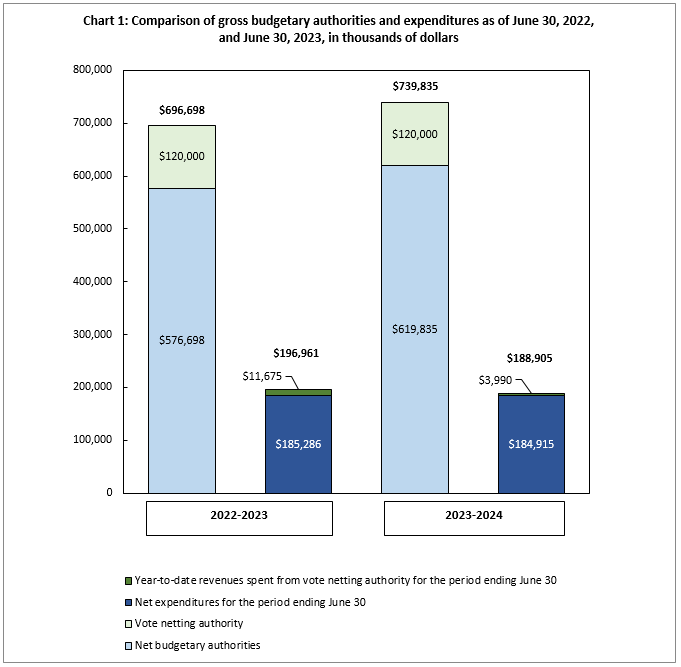
Comparison of gross budgetary authorities and expenditures as of June 30, 2022, and June 30, 2023, in thousands of dollars
Description for Chart 1: Comparison of gross budgetary authorities and expenditures as of June 30, 2022, and June 30, 2023, in thousands of dollars

This bar graph shows Statistics Canada's budgetary authorities and expenditures, in thousands of dollars, as of June 30, 2022 and 2023:

  • As at June 30, 2022
    • Net budgetary authorities: $576,698
    • Vote netting authority: $120,000
    • Total authority: $696,698
    • Net expenditures for the period ending June 30: $185,286
    • Year-to-date revenues spent from vote netting authority for the period ending June 30: $11,675
    • Total expenditures: $196,961
  • As at June 30, 2023
    • Net budgetary authorities: $619,835
    • Vote netting authority: $120,000
    • Total authority: $739,835
    • Net expenditures for the period ending June 30: $184,915
    • Year-to-date revenues spent from vote netting authority for the period ending June 30: $3,990
    • Total expenditures: $188,905

Chart 1 outlines the gross budgetary authorities, which represent the resources available for use for the year as of June 30.

Significant changes to authorities

Total authorities available for 2023-24 have increased by $43.1 million, or 6.2%, from the previous year, from $696.7 million to $739.8 million (Chart 1). The net increase is mostly the result of the following:

  • An increase of $87.2 million for funding received to cover the initial planning phase and development activities related to the 2026 Census of Population and 2026 Census of Agriculture programs;
  • A decrease of $48 million for the 2021 Census of Population and 2021 Census of Agriculture programs due to cyclical nature of funding winding down;
  • A decrease of $1.8 million for the Disaggregated Data Action Plan;
  • An increase of $1.3 million for salary increases related to latest rounds of collective bargaining;
  • An increase of $6.7 million for various initiatives including Statistical Survey Operations Modernization, Canada Dental Benefit, Federal Action Plan to Strengthen Internal Trade, Higher Education Intellectual Property Commercialization and Advancing a Circular Plastics Economy for Canada.

In addition to the appropriations allocated to the agency through the Main Estimates, Statistics Canada also has vote net authority within Vote 1, which entitles the agency to spend revenues collected from other federal government departments, agencies, and external clients to provide statistical services. The vote netting authority is stable at $120 million when comparing the first quarter of fiscal years 2022-2023 and 2023-2024.

Significant changes to expenditures

Year-to-date net expenditures recorded to the end of the first quarter decreased by $0.4 million, or 0.2% from the previous year, from $185.3 million to $184.9 million (see Table A: Variation in Departmental Expenditures by Standard Object).

Statistics Canada spent approximately 29.8% of its authorities by the end of the first quarter, compared with 32.1% in the same quarter of 2022-2023.

Table A: Variation in Departmental Expenditures by Standard Object (unaudited)
This table displays the variance of departmental expenditures by standard object between fiscal 2021-2022 and 2022-2023. The variance is calculated for year to date expenditures as at the end of the first quarter. The row headers provide information by standard object. The column headers provide information in thousands of dollars and percentage variance for the year to date variation.
Departmental Expenditures Variation by Standard Object: Q1 year-to-date variation between fiscal year 2022-2023 and 2023-2024
$'000 %
(01) Personnel -6,633 -3.9
(02) Transportation and communications 393 11.0
(03) Information 1 0.1
(04) Professional and special services 1,834 22.1
(05) Rentals -1,641 -16.2
(06) Repair and maintenance -69 -44.8
(07) Utilities, materials and supplies -140 -65.1
(08) Acquisition of land, buildings and works - N/A
(09) Acquisition of machinery and equipment -1,141 -72.5
(10) Transfer payments - N/A
(12) Other subsidies and payments -660 -79.8
Total gross budgetary expenditures -8,056 -4.1
Less revenues netted against expenditures:
Revenues -7,685 -65.8
Total net budgetary expenditures -371 -0.2
Note: Explanations are provided for variances of more than $1 million.

Personnel: The decrease is mainly due to spendings for seasonal, casual, and students' salaries, offset by a slight increase related to cost-recovery work following the dissemination of the 2021 Census of Population.

Professional and special services: The increase is mainly due to expenses with IT consultants and timing difference in invoicing compared to the first quarter of 2022-2023.

Rentals: The decrease is mainly due to a one-time invoice for a software licence paid in the first quarter of 2022-2023.

Acquisition of machinery and equipment: The decrease is mainly due to the purchase of computers in the first quarter of 2022-2023.

Revenues: The decrease is mainly due to a timing difference in invoicing compared to last year.

C) Significant changes to operations, personnel and programs

In 2023-2024, the following changes in operations and program activities are underway:

  • The Census program is ramping down operations for the 2021 cycle and is in the planning phase for the 2026 Censuses of Population and Agriculture programs.
  • Budget 2023 announced funding for new initiatives such as the Canadian Dental Care program and the Official Languages Action Plan.
  • Budget 2023 announced a commitment to refocus government spending:
    • Budget 2023 proposes to reduce spending on consulting, other professional services, and travel by roughly 15 per cent starting in 2023-2024. The government will focus on targeting these reductions on professional services, particularly management consulting.
    • Budget 2023 proposes to phase in a roughly 3 per cent reduction of eligible spending by departments and agencies by 2026-2027.
  • Statistics Canada is committed to effective management of its programs and services. In anticipation of the announcement of pending reductions, Statistics Canada launched a review in 2022 to identify efficiencies and reductions to programs or services.

D) Risks and uncertainties

Statistics Canada will address the issues and corresponding uncertainties raised in this Quarterly Financial Report by implementing corresponding risk mitigation measures captured in the 2023-2024 Corporate Risk Profile and at the program level.

Statistics Canada continues to pursue and invest in modernizing business processes and tools to maintain its relevance and maximize the value it provides to Canadians. To address uncertainties, the agency is implementing the Census of Environment, the Quality of Life Framework for Canada and the Disaggregated Data Action Plan initiatives to meet the evolving needs of users and remain relevant as an agency. The agency is also remaining vigilant to cyber threats while supporting the use of modern methods with a functional digital infrastructure.

Statistics Canada requires a skilled workforce to achieve its objectives; however, it is difficult to compete with other organizations in the data ecosystem and the current labour market situation. To address uncertainties, Statistics Canada will create partnerships with other government departments, international organizations, and IT Industry partners to find innovative ways to collaborate on bridging gaps in digital skills and IT human resource shortfalls. The agency will continue promoting a strong workplace culture, a healthy work-life balance and advance on the Equity, Diversity and Inclusion Action Plan. In addition, it will focus on existing employees and continue its effort to achieve greater diversity and inclusion across its workforce and promote and support accessibility.

Statistics Canada continues its collaboration with federal partners to access IT services and support to realise its modernization objectives and to implement the Cloud Optimization Activities. To address uncertainties, the agency is working closely with its federal partners, while adhering to the agency's notable financial planning management practices, integrated strategic planning framework as well as strengthening its financial stewardship.

Approval by senior officials

Approved by:

Anil Arora, Chief Statistician
Ottawa, Ontario
Signed on: August 23rd, 2023

Kathleen Mitchell, Chief Financial Officer
Ottawa, Ontario
Signed on: August 15th, 2023

Appendix

Statement of Authorities (unaudited)
This table displays the departmental authorities for fiscal years 2022-2023 and 2023-2024. The row headers provide information by type of authority, Vote 105 – Net operating expenditures, Statutory authority and Total Budgetary authorities. The column headers provide information in thousands of dollars for Total available for use for the year ending March 31; used during the quarter ended June 30; and year to date used at quarter-end of both fiscal years.
  Fiscal year 2023-2024 Fiscal year 2022–2023
Total available for use for the year ending March 31, 2024Table note * Used during the quarter ended June 30, 2023 Year-to-date used at quarter-end Total available for use for the year ending March 31, 2023Table note * Used during the quarter ended June 30, 2022 Year-to-date used at quarter-end
in thousands of dollars
Vote 1 — Net operating expenditures 530,377 166,191 166,191 496,731 165,294 165,294
Statutory authority — Contribution to employee benefit plans 89,458 18,724 18,724 79,967 19,992 19,992
Total budgetary authorities 619,835 184,915 184,915 576,698 185,286 185,286
Table note *

Includes only Authorities available for use and granted by Parliament at quarter-end.

Return to the first table note * referrer

Departmental budgetary expenditures by Standard Object (unaudited)
This table displays the departmental expenditures by standard object for fiscal years 2022-2023 and 2023-2024. The row headers provide information by standard object for expenditures and revenues. The column headers provide information in thousands of dollars for planned expenditures for the year ending March 31; expended during the quarter ended June 30; and year to date used at quarter-end of both fiscal years.
  Fiscal year 2023-2024 Fiscal year 2022–2023
Planned expenditures for the year ending March 31, 2024 Expended during the quarter ended June 30, 2023 Year-to-date used at quarter-end Planned expenditures for the year ending March 31, 2023 Expended during the quarter ended June 30, 2022 Year-to-date used at quarter-end
in thousands of dollars
Expenditures:
(01) Personnel 636,127 164,220 164,220 613,079 170,853 170,853
(02) Transportation and communications 11,992 3,979 3,979 11,745 3,586 3,586
(03) Information 8,682 1,340 1,340 9,041 1,339 1,339
(04) Professional and special services 48,413 10,120 10,120 35,898 8,286 8,286
(05) Rentals 21,089 8,487 8,487 17,160 10,128 10,128
(06) Repair and maintenance 972 85 85 475 154 154
(07) Utilities, materials and supplies 1,642 75 75 1,736 215 215
(08) Acquisition of land, buildings and works 557 - - 555 - -
(09) Acquisition of machinery and equipment 10,304 432 432 6,962 1,573 1,573
(10) Transfer payments - - - - - -
(12) Other subsidies and payments 57 167 167 47 827 827
Total gross budgetary expenditures 739,835 188,905 188,905 696,698 196,961 196,961
Less revenues netted against expenditures:
Revenues 120,000 3,990 3,990 120,000 11,675 11,675
Total revenues netted against expenditures 120,000 3,990 3,990 120,000 11,675 11,675
Total net budgetary expenditures 619,835 184,915 184,915 576,698 185,286 185,286